

Kazuo Ishiguro signed first editions sit near the top of modern literary collecting, and it’s easy to see why. A Booker winner for The Remains of the Day and a Nobel laureate since 2017, he has published just nine novels in four decades, so each new book is an event and early firsts stay scarce. Never Let Me Go (2005) and Klara and the Sun (2021) are the other key titles, and with Taika Waititi’s film of Klara reaching cinemas in October 2026, fresh readers are heading back to the whole shelf.


Kazuo Ishiguro SIGNED The Buried Giant True UK 1st Edition 1st Print Hardcover
🇺🇸 Price: US $184.99
Buy It Now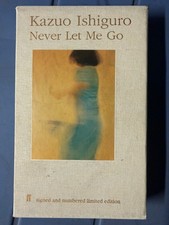
Kazuo Ishiguro / NEVER LET ME GO Signed Limited 1st Edition 2005. #28/1000
🇺🇸 Price: US $600.00
Buy It Now
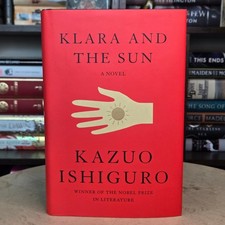
KAZUO ISHIGURO SIGNED - KLARA AND THE SUN Hardcover First Edition NOBEL
🇺🇸 Price: US $199.99
Buy It Now


Never Let Me Go SIGNED Kazuo Ishiguro Easton Press NEW Sealed Nobel Prize 1st
🇺🇸 Price: US $199.95
Buy It Now
SIGNED Klara and The Sun by Kazuo Ishiguro FIRST EDITION (2021, Hardcover)
🇺🇸 Price: US $150.00
Buy It Now
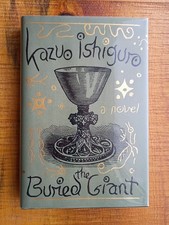

Kazuo Ishiguro SIGNED - Never Let Me Go - 1st/1st 2005 Faber - Excellent
🇺🇸 Price: US $321.74
Buy It Now


Signed By Author is an eBay affiliate. We may earn a commission from qualifying purchases.
About Kazuo Ishiguro
Kazuo Ishiguro was born in Nagasaki, Japan, in 1954 and moved to Britain with his family when he was five years old, growing up in the West but always carrying the sensibilities and memories of his Japanese heritage. This dual perspective—of being shaped by one culture while observing another—permeates his fiction, lending it a quiet, reflective sensibility. Ishiguro’s work is spare yet emotionally resonant, revealing the complexities of memory, identity, and human longing with subtlety and precision. Across his novels, he explores how people reconstruct their pasts, often deceiving themselves in order to live with their regrets, choices, and desires.
His debut novel, A Pale View of Hills (1982), set in postwar Japan, introduced readers to his fascination with memory, loss, and the selective nature of recollection. Told through the eyes of an Englishwoman reflecting on her life in Japan after the war, it investigates grief, guilt, and the silences that can shape relationships. An Artist of the Floating World (1986) expanded these themes, examining a retired painter grappling with his complicity in a society devastated by conflict. Through subtle narration and understated dialogue, Ishiguro conveys the psychological weight of self-deception and the way individuals justify or obscure their past actions, particularly in the shadow of historical trauma.
The author’s international breakthrough came with The Remains of the Day (1989), a novel that remains a touchstone of modern literary fiction. Its protagonist, Stevens, an ageing English butler, reflects on decades of service to an English lord, revealing how devotion, pride, and repression shape his understanding of duty and personal emotion. The narrative’s restrained elegance captures the quiet tragedies of a life lived in the service of others, where emotional expression is subordinated to propriety. Winning the Booker Prize, the novel exemplifies Ishiguro’s gift for depicting regret and the unspoken consequences of loyalty, offering a story that is at once intimate and profoundly universal.
With The Unconsoled (1995) and When We Were Orphans (2000), Ishiguro experimented with structure and narrative perspective, venturing into dreamlike and sometimes disorienting territories. These novels explore how memory and perception shape reality, and how individuals navigate a world where the past is unstable and meaning often elusive. The Unconsoled in particular challenges conventional storytelling, immersing readers in a labyrinthine narrative that mirrors the protagonist’s confusion and obsession, further demonstrating Ishiguro’s willingness to innovate while remaining attentive to emotional truth.
His later works solidified his reputation as a master of emotional subtlety and philosophical depth. Never Let Me Go (2005) is a haunting meditation on mortality, ethics, and humanity within a dystopian framework, exploring the ethical dilemmas of a society that commodifies human life. The Buried Giant (2015) combines myth and history, telling a story of aging, memory, and forgiveness in post-Arthurian Britain, reflecting Ishiguro’s enduring fascination with how societies—and individuals—choose to forget or remember. Across these works, he maintains a delicate balance of understated prose, moral inquiry, and psychological insight, offering readers narratives that linger long after the final page.
In 2017, Ishiguro was awarded the Nobel Prize in Literature for his novels, which “uncovered the abyss beneath our illusory sense of connection with the world.” Whether portraying a butler haunted by duty, a student confronted with a dystopian reality, or a community wrestling with collective memory, Ishiguro captures the fragility and resilience of human consciousness. His work resonates across cultures, offering quiet yet profound reflections on love, loss, and the unending search for meaning in a world shaped by memory, imagination, and moral reckoning.
His first novel after the Nobel, Klara and the Sun (2021), is narrated by an Artificial Friend, a solar-powered android who keeps watch over a sickly teenage girl, and asks what love and loyalty might look like in a machine. Taika Waititi’s film adaptation, starring Jenna Ortega and Amy Adams, hit cinemas in October 2026, sending a fresh wave of readers back to the novel, and to the rest of his work.
Kazuo Ishiguro illustration based on a photography by Frankie Fouganthin, CC BY-SA 4.0, via Wikimedia Commons.
