

Barbara Kingsolver signed first editions carry real weight with collectors, and her standing has only grown since Demon Copperhead swept the Pulitzer and the Women’s Prize in 2023, making her the only author to win the latter twice. Early editions of The Poisonwood Bible (1998) and The Lacuna (2010) already command serious attention, while first printings of Demon Copperhead itself are becoming steadily harder to source in fine condition. With a body of work spanning literary fiction, nonfiction and poetry, and honours including the National Humanities Medal, Kingsolver’s signed first editions represent a genuinely well-founded long-term investment.


The Lacuna by Barbara Kingsolver 2009 1st Edition HC/DJ SIGNED by Author
🇺🇸 Price: US $14.39
Buy It Now

Pigs In Heaven - Barbara Kingsolver (1993 Hardcover) SIGNED FIRST EDITION
🇺🇸 Price: US $19.96
Buy It Now


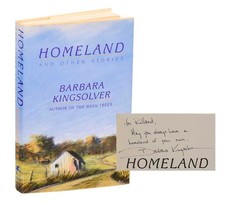
Barbara Kingsolver / Homeland and Other Stories 1st Edition 1989 Signed
🇺🇸 Price: US $100.00
Buy It Now
Pigs in Heaven, Barbara Kingsolver (1993/First Edition/Signed/Paperback)
🇺🇸 Price: US $20.00
Buy It Now
BARBARA KINGSOLVER Signed Pigs in Heaven FIRST EDITION Hardcover w/DJ
🇺🇸 Price: US $50.00
Buy It Now
THE LACUNA - BARBARA KINGSOLVER - 1ST ED. - SIGNED - 2009 - DJ UNCLIPPED.
🇺🇸 Price: US $60.00
Buy It NowSigned By Author is an eBay affiliate. We may earn a commission from qualifying purchases.
About Barbara Kingsolver
Barbara Kingsolver was born on April 8, 1955, in Annapolis, Maryland, and grew up in rural Kentucky, where her father worked as the only doctor in Nicholas County. It was an unusual childhood in some ways, a household that had little patience for television and a lot of patience for books, and Kingsolver has said the county’s travelling bookmobile did more for her early education than almost anything else. She left home for college with an interest in science rather than literature, studying biology at DePauw University, where she graduated magna cum laude in 1977, and went on to a master’s degree in ecology and evolutionary biology at the University of Arizona in 1981.
For a while it looked like her career would run through laboratories rather than novels. She worked as a freelance science writer and journalist through the early and mid-1980s, with pieces appearing in outlets including The Progressive and Smithsonian. That scientific training never really left her writing, it surfaces again and again in the way she handles ecology, biology and the natural world as subjects in their own right rather than as backdrop.
Her first novel, The Bean Trees, appeared in 1988, introducing a young Kentucky woman who ends up raising an abandoned Cherokee toddler after fleeing west, and it set the tone for what would follow: character-driven storytelling, unmistakably political without losing sight of the people at its centre. Animal Dreams and Pigs in Heaven followed in the early nineties, building a devoted readership before her most internationally recognised novel arrived. The Poisonwood Bible, published in 1998, follows an American missionary family unravelling in the Belgian Congo during the country’s fight for independence, and it became a finalist for both the Pulitzer Prize and the Orange Prize, an early sign of the scale Kingsolver’s ambitions could reach within literary fiction.
The 2000s brought The National Humanities Medal in 2000, America’s highest honour for service through the arts, along with novels including Prodigal Summer and, in 2010, The Lacuna, a sweeping historical work that won Britain’s Orange Prize for Fiction. Alongside her novels she has written poetry, essays and nonfiction, most notably Animal, Vegetable, Miracle, a memoir of a year spent eating only what her family could grow or source locally, which became a substantial bestseller in its own right and picked up a James Beard award along the way.
It was Demon Copperhead, published in 2022, that took her career to an entirely new register. A retelling of Dickens’s David Copperfield transplanted into the opioid crisis of contemporary Appalachia, the novel became both a critical sensation and a genuine cultural moment, an Oprah’s Book Club pick that readers pressed on one another with real urgency. It won the Pulitzer Prize for Fiction in 2023, and the Women’s Prize for Fiction the same year, making Kingsolver the first author in the prize’s history to win it twice, having already taken it for The Lacuna over a decade earlier.
Kingsolver has spent much of her adult life exactly where her fiction lives, close to the land and deeply engaged with questions of community, justice and the natural world. She founded what has become the PEN/Bellwether Prize for Socially Engaged Fiction, supporting new writers working in the same politically alert tradition she has occupied for decades. She lives with her husband, Steven Hopp, on a farm in southern Appalachia, a landscape that has shaped her recent work as thoroughly as Kentucky shaped her first.
Now in her seventies, and with Demon Copperhead having introduced her to a substantial new readership, Kingsolver’s standing looks more secure than ever, an author whose best-known book may yet turn out to have arrived not at the end of her career but somewhere in its middle.
Illustration of Barbara Kingsolver based on a photograph by Terry Ballard, CC BY 2.0, via Wikimedia Commons
