Umberto Eco signed first editions sit at an unusual crossing point between literary collecting and intellectual history, given his standing as both a major semiotician and a bestselling historical novelist. The Name of the Rose (1980), winner of the Premio Strega and later adapted into a Sean Connery film, remains his most collected work, with Foucault’s Pendulum (1988) close behind. Early Italian and English first editions in fine condition are increasingly hard to find. For collectors interested in an author whose academic reputation adds real depth to the collecting narrative, Eco is a name worth serious attention.


SIGNED The Island of the Day Before — Umberto Eco | 1st US Edition 1995 HC
🇺🇸 Price: US $89.95
Buy It Now
Umberto Eco THE ISLAND OF THE DAY BEFORE Signed Inscribed 1st HC DJ 1995
🇺🇸 Price: US $69.95
Buy It Now
BAUDOLINO Umberto Eco SIGNED 1st Edition First Printing NOVEL Fiction
🇺🇸 Price: US $62.97
Buy It Now


The Franklin Library SIGNED FIRST EDITION full leather bound, 12 titles
🇺🇸 Price: US $149.99
Buy It Now


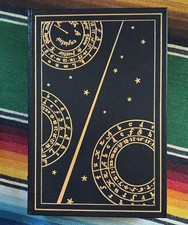
Signed Umberto Eco Foucault's Pendulum Franklin Library Leather 1st Edition
🇺🇸 Price: US $150.00
Buy It Now

Umberto Eco / Serendipities: Language and Lunacy / Signed First Edition / 1998
🇺🇸 Price: US $165.00
Buy It Now


Umberto Eco Signed 1st Ed 2007 On Ugliness Aesthetics Hardcover w/Dustjacket
🇺🇸 Price: US $300.00
Buy It NowSigned By Author is an eBay affiliate. We may earn a commission from qualifying purchases.
About Umberto Eco
Umberto Eco was born on January 5, 1932, in Alessandria, a small town in Piedmont, the only son of an accountant. His father wanted him to study law, but Eco enrolled at the University of Turin to pursue medieval philosophy and literature instead, writing his thesis on Thomas Aquinas under the philosopher Luigi Pareyson and graduating in 1954. That thesis became his first book, and it set the pattern for a career that would move fluidly between rigorous scholarship and popular storytelling for the rest of his life.
Long before he was known as a novelist, Eco had already established himself as one of Europe’s most influential thinkers. He worked as a cultural editor for Italian state television before returning to academic life, and by the 1960s he was a central figure in semiotics, the study of how signs and symbols generate meaning. His 1962 book The Open Work argued that modern texts invite active interpretation rather than passive reception, and A Theory of Semiotics, published in 1976, became a foundational text in the field. He co-founded the semiotic journal VS in 1971 and spent much of his career as professor at the University of Bologna, where he remained emeritus at his death. He held more than thirty honorary doctorates and was made a Chevalier de la Légion d’Honneur by the French government, honours that reflected a reputation built almost entirely outside fiction.
Then, in 1980, at the age of forty-eight, Eco published his first novel. The Name of the Rose is set in a fourteenth-century Italian monastery, where a Franciscan friar investigates a string of deaths against a backdrop of theological conflict and forbidden knowledge, working the same historical fiction terrain that Ken Follett and Hilary Mantel occupy on this site, though filtered through Eco’s own scholarly obsessions with signs, symbols, and the unreliability of texts. It won Italy’s Premio Strega and the French Prix Médicis Étranger, sold more than a million copies in hardcover in the United States alone, and was translated into over thirty-five languages. Jean-Jacques Annaud’s 1986 film adaptation, starring Sean Connery as the investigating friar, brought Eco’s name to audiences who would never open one of his academic texts, and the novel has never really left print since.
He followed it with Foucault’s Pendulum in 1988, a denser, more paranoid book weaving conspiracy theory, the occult, and publishing house intrigue into something several critics considered even more accomplished than his debut. The Island of the Day Before (1994) took him to the seventeenth century and a castaway adrift on an empty ship, while Baudolino (2000) returned to the medieval world for the picaresque adventures of a gifted liar navigating the Fourth Crusade. The Prague Cemetery, published in 2010, was his darkest historical work, tracing the fabrication of an antisemitic forgery through nineteenth-century Europe, and became an international bestseller in its own right.
What distinguished Eco from most novelists working in historical settings was that the fiction never stood apart from the theory. His novels function as extensions of his semiotic thinking, treating history itself as a system of signs to be decoded, and that double reputation, as both serious philosopher and bestselling storyteller, is unusual even among writers as accomplished as he was. Few authors have moved so convincingly between a university lecture hall and a bestseller list.
Eco continued publishing essays, children’s books, and newspaper columns until shortly before his death in Milan on February 19, 2016. His scholarly and fictional legacies are, by now, difficult to separate, and both continue to shape how readers and academics alike think about the relationship between texts, history, and meaning.
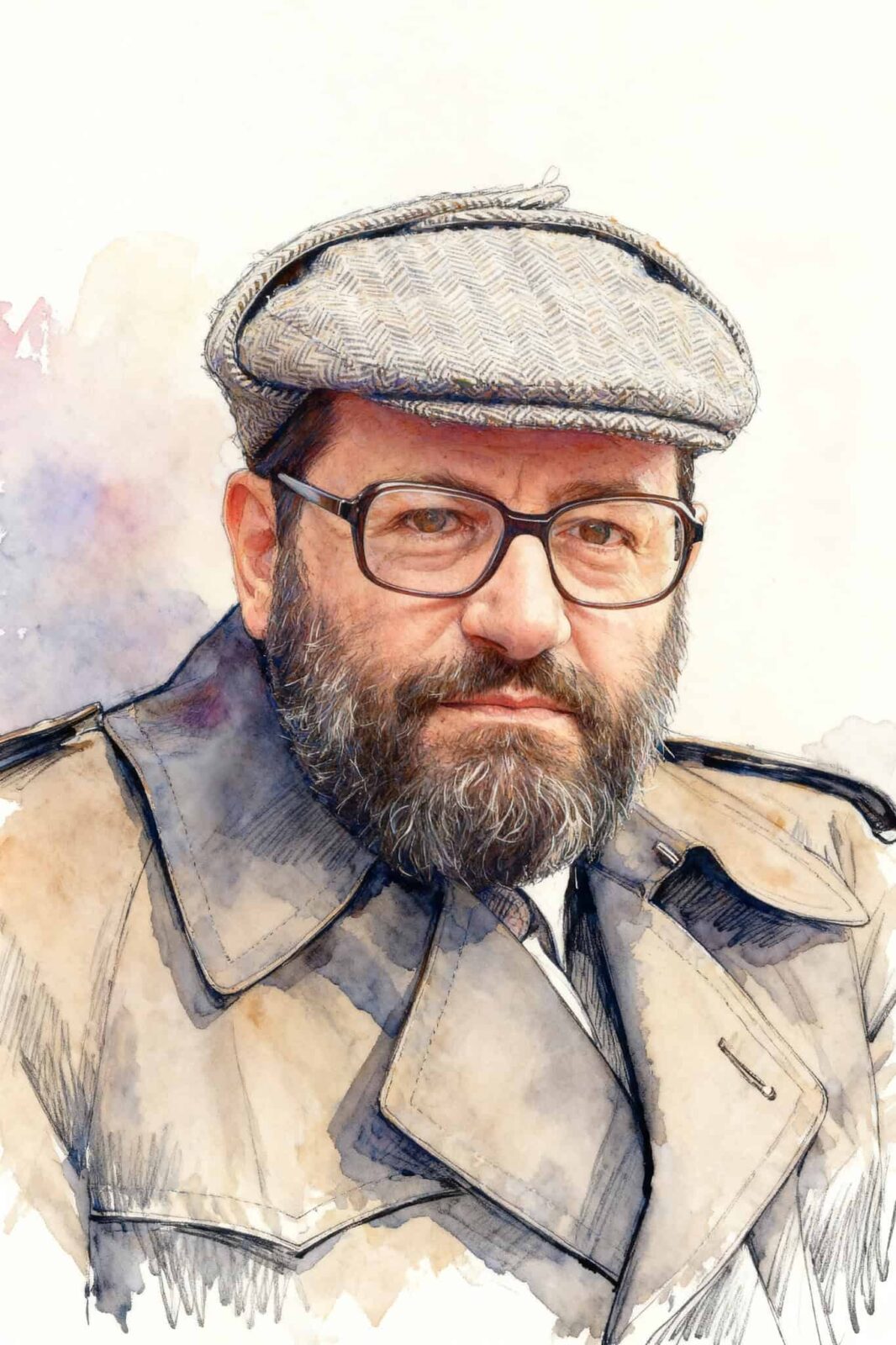
Illustration of Umberto Eco based on a photograph by Bogaerts, Rob / Anefo, CC0, via Wikimedia Commons.
