
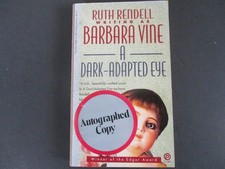
Ruth Rendell signed first editions represent one of the stronger long-term propositions in British crime fiction collecting. A four-time CWA Gold Dagger winner, Diamond Dagger recipient, MWA Grand Master, and Baroness, Rendell’s literary standing is unassailable, and demand for her early work is steady. First editions of A Judgement in Stone (1977) and the early Barbara Vine novels, particularly A Dark-Adapted Eye (1986) and A Fatal Inversion (1987), are especially desirable, and copies in fine condition with dust jackets are not easy to find. With three distinct bodies of work to collect across the Wexford series, the standalone novels, and the Vine imprint, there is real depth to a Rendell collection. For serious collectors, she remains a very sound investment.

Signed By Author is an eBay affiliate. We may earn a commission from qualifying purchases.
← Back to full listingsAbout Ruth Rendell
Ruth Barbara Grasemann was born in South Woodford, Essex, in 1930, the daughter of two teachers. Her mother was Swedish-Danish by background, and the family spent holidays in Scandinavia, which left Rendell with both a feel for Northern European sensibility and a working knowledge of Swedish and Danish. She left school and went into local newspaper journalism, working as a reporter and sub-editor for the Chigwell Times in the late 1940s and early 1950s. She married Donald Rendell in 1950 and they had one son, Simon.
Her first novel, From Doon with Death, appeared in 1964 and introduced Chief Inspector Wexford, a methodical, humane, and quietly observant detective working in the fictional Sussex town of Kingsmarkham. Wexford would go on to anchor more than twenty novels across five decades, but from early on Rendell was writing a second strand of work alongside the series, darker and more psychologically intense, exploring the inner lives of criminals, obsessives, and people undone by misunderstanding or misfortune. These standalone novels, among them A Judgement in Stone (1977) and Live Flesh (1986), established her reputation in crime & thrillers as something beyond a series writer.
In 1986 she went further still, adopting the pseudonym Barbara Vine for a third strand of fiction: slower, more literary, more interested in the buried dynamics of families and the long aftermath of hidden events. The name came from her own middle name and her great-grandmother’s maiden name. A Dark-Adapted Eye, the first Vine novel, won the Edgar Award for Best Novel from the Mystery Writers of America. A Fatal Inversion followed in 1987 and won the CWA Gold Dagger. The Vine novels attracted a slightly wider readership, and many critics considered them her finest work. Rendell herself said the pseudonym gave her a different kind of freedom.
The awards accumulated across all three strands. She holds four CWA Gold Daggers, a record, as well as the CWA Diamond Dagger for lifetime achievement and the Mystery Writers of America Grand Master Award. The Gold Dagger record alone tells you something about the consistency of her output over more than thirty years. She was appointed CBE in 1996 and became Baroness Rendell of Babergh the following year, taking a seat in the House of Lords as a Labour peer, one of a small group of British crime writers to reach that level of public distinction.
The television adaptations were extensive and long-running. The Inspector Wexford series, broadcast under the title The Ruth Rendell Mysteries, ran for 48 episodes on ITV between 1987 and 2000, with George Baker playing Wexford to considerable popular approval. Several of the Barbara Vine novels were adapted by the BBC to strong effect, including A Dark-Adapted Eye and Gallowglass. A Judgement in Stone was also memorably adapted as a French-language film, La Ceremonie, by Claude Chabrol in 1995, which introduced her to an entirely different European audience. She died in May 2015, following a stroke, at the age of eighty-five. Over fifty years of writing she produced more than sixty novels across her three distinct lines of work, and the critical consensus is that any one of those lines would have been enough to secure a lasting reputation. Taken together, they make her one of the most significant crime writers Britain has produced.
Illustration of Ruth Rendell based on a photograph by Gotfryd, Bernard, photographer, Public domain, via Wikimedia Commons.
