
Sue Grafton signed first editions are among the most sought-after items in American crime fiction collecting, and their scarcity has only sharpened since her death in 2017. The early alphabet novels are the prime targets: A is for Alibi (1982) had a first print run of around seven thousand copies, and fine signed examples are genuinely hard to track down. G is for Gumshoe and the mid-series titles, where the books crossed into international bestseller territory, also attract serious collector interest. A Grand Master of the Mystery Writers of America and a CWA Diamond Dagger recipient, Grafton’s reputation is firmly established. With no adaptations and no continuation of the series, the original novels are all there is. That alone makes them worth knowing.

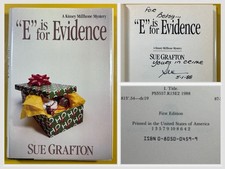

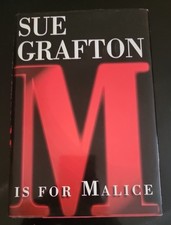
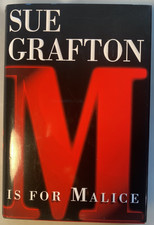
Sue Grafton Signed First Edition M is for Malice 1996 HC/DJ Mystery Novel
🇺🇸 Price: US $40.00
Buy It Now

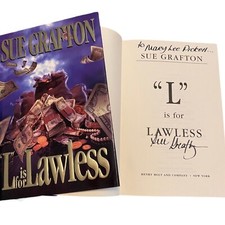
Sue Grafton "L Is For Lawless" Signed Autographed First Edition Hardcover
🇺🇸 Price: US $14.00
Buy It Now
Sue Grafton "J Is For Judgment" Signed Autographed First Edition Hardcover
🇺🇸 Price: US $14.00
Buy It Now

"J" IS FOR JUDGMENT, Sue Grafton, Signed, First Edition & Printing. VF
🇺🇸 Price: US $12.00
Buy It Now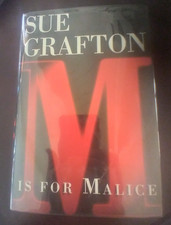

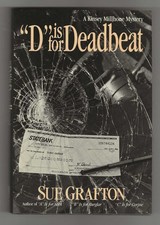
Sue Grafton D IS FOR DEADBEAT First edition First printing SIGNED Mystery Fine
🇺🇸 Price: US $175.00
Buy It Now


Signed By Author is an eBay affiliate. We may earn a commission from qualifying purchases.
About Sue Grafton
Sue Grafton was born in Louisville, Kentucky, in 1940, the daughter of C.W. Grafton, a municipal bond lawyer who also wrote mystery novels on the side. It was a literary household in its way, and she began writing seriously in her late teens. Her first two published novels, Keziah Dane (1967) and The Lolly-Madonna War (1969), attracted little attention, and for the next fifteen years she largely set fiction aside, earning a living writing screenplays for television movies. It was a practical career, not a passionate one, and she never fully settled into it.
The change came in the early 1980s, during a difficult period in her personal life. Working through a painful divorce and custody battle, Grafton found herself with some very dark thoughts about her ex-husband and decided, as she later put it, to channel them into fiction rather than action. The result was A is for Alibi, published in 1982, which introduced Kinsey Millhone, a sharp, self-reliant private investigator working out of the fictional California coastal city of Santa Teresa. The first print run was around seven thousand copies. Within a few years it was clear that something significant had happened.
Kinsey Millhone was genuinely new: a female hard-boiled PI in a tradition that had been almost exclusively male, tough and funny and thoroughly her own person, living in a converted garage and eating peanut butter straight from the jar. The alphabet conceit, one novel per letter, gave the series a built-in momentum, and Grafton honoured it rigorously. By the time she reached the middle letters the books were international bestsellers, translated into twenty-six languages, with readers who followed each new instalment as a kind of annual event. She sat firmly within crime & thrillers, but she was also doing something more: bringing literary seriousness and social observation to a form that did not always demand it.
The honours reflected that. She was named a Grand Master by the Mystery Writers of America, the organisation’s highest recognition for a career’s achievement. She received the CWA Cartier Diamond Dagger from Britain’s Crime Writers’ Association, three Anthony Awards, and three Shamus Awards from the Private Eye Writers of America, among a considerable number of others. She was, by any measure, one of the most decorated crime writers of her generation on both sides of the Atlantic.
Grafton was notably protective of her work and her character. She declined all offers to adapt the Kinsey Millhone novels for film or television, and was explicit that she did not want the series continued under a ghost writer after her death. When she died in December 2017, having completed Y is for Yesterday but not yet begun Z, her family honoured her wishes. The alphabet ends at Y. That decision, unusual and not universally welcomed by readers, has if anything increased the cultural weight of the series as a whole, giving it a finality that ongoing franchises rarely achieve.
She left behind twenty-five novels, a body of work that shifted the landscape of crime fiction and proved that the hard-boiled private eye novel could belong just as fully to a woman writer as to any of its male predecessors. Her influence on subsequent generations of crime writers, particularly women working in the genre, is considerable and openly acknowledged.
Illustration of Sue Grafton based on a photograph by Mark Coggins from San Francisco, CC BY 2.0, via Wikimedia Commons.
