Orhan Pamuk signed first editions carry the weight of a Nobel laureate whose historical novels, above all My Name Is Red and The White Castle, sit among the most acclaimed works of the genre to emerge from outside the Western canon. First editions from before his 2006 Nobel win are increasingly scarce, and interest in The Museum of Innocence has picked up further following its 2026 Netflix adaptation. With a body of work translated into more than sixty languages and a reputation still growing, Pamuk represents a genuinely international collecting opportunity with strong long-term prospects.

SIGNED - OTHER COLORS by Orhan Pamuk - 1st/1st HCDJ 2007- Nobel Prize
🇺🇸 Price: US $112.50
Buy It Now

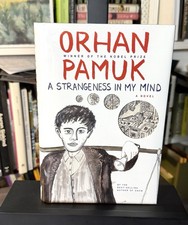
Orhan Pamuk / A Strangeness in my Mind / 1st US Ed. / Signed / Knopf, 2015
🇺🇸 Price: US $45.00
Buy It Now

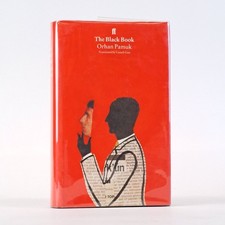


Orhan Pamuk / OTHER COLORS ESSAYS AND A STORY Signed 1st Edition 2007
🇺🇸 Price: US $60.00
Buy It Now
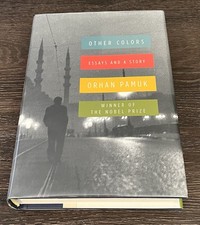

SIGNED Orhan Pamuk SNOW 2004 Alfred A. Knopf, NY First American Edition HC/DJ
🇺🇸 Price: US $200.00
Buy It Now

SIGNED & DATED - The Red-Haired Woman by Orhan Pamuk, 1st/1st, HARDCOVER
🇺🇸 Price: US $102.03
Buy It Now
SIGNED - A Strangeness in my Mind by Orhan Pamuk, 1st US Ed/1st, HARDCOVER
🇺🇸 Price: US $102.03
Buy It Now
"The New Life" by Orhan Pamuk. Signed 1st US edition. 1997. Nobel Prize winner
🇺🇸 Price: US $100.00
Buy It NowSigned By Author is an eBay affiliate. We may earn a commission from qualifying purchases.
About Orhan Pamuk
Orhan Pamuk was born in Istanbul in 1952, into a wealthy family whose fortune, built by his grandfather’s railway business, had largely dissolved by the time he reached adulthood. He grew up wanting to be a painter, attended the American-run Robert College, then studied architecture at Istanbul Technical University before abandoning it, and later took a degree in journalism at Istanbul University. None of it quite stuck. What did stick was writing, which he began in earnest in 1974, shutting himself away in his family’s Istanbul apartment for years at a stretch to work on his first novel.
That debut, Cevdet Bey and His Sons, appeared in 1982, tracing three generations of a wealthy Istanbul family across the fall of the Ottoman Empire and the uncertain first decades of the Turkish republic. Silent House followed a year later, told through five shifting narrators gathered at a seaside house on the eve of Turkey’s 1980 military coup. It was his third novel, The White Castle, published in 1985, that carried him beyond Turkey for the first time, a slippery, historical tale of a Venetian scholar enslaved by an Ottoman master in seventeenth century Istanbul, in which the two men’s identities gradually, unsettlingly, merge.
The 1990s brought The Black Book, a dense, riddling portrait of Istanbul that became one of the most argued-over novels in Turkish literature, and The New Life, which sold faster on publication than any book in the country’s history to that point. But it was My Name Is Red, published in 1998, that established him internationally on a different scale, a murder mystery set among the miniaturist painters of the sixteenth century Ottoman court, structured so that even the corpse gets a turn to narrate. It won the Prix du Meilleur Livre Étranger, the Premio Grinzane Cavour, and the International Dublin Literary Award, and remains, alongside The White Castle, his clearest claim on historical fiction as a genre.
Snow, published in 2002, moved into the present day, following a poet returning from exile to a remote Turkish town caught between secularism and religious conservatism, a book that read, to many, as a startlingly direct engagement with the tensions defining Turkey at the time. Pamuk has never been shy of those tensions. He has spoken openly on the Armenian and Kurdish questions in Turkish history, was prosecuted in 2005 for remarks on the Armenian genocide before the charges were dropped amid international protest, and has lived for periods outside Turkey under police protection following threats to his safety.
In 2006 he became the first Turkish writer to receive the Nobel Prize in Literature, the Swedish Academy citing his pursuit, in his own words, of the melancholic soul of his native city, and his gift for finding new symbols for the meeting and friction of cultures. The Museum of Innocence followed in 2008, an obsessive love story set across Istanbul society, which Pamuk extended into physical form by opening an actual museum of objects from the novel in an Istanbul house he bought for the purpose. Netflix adapted the novel into a limited series that premiered in early 2026, introducing the book to an entirely new audience decades after publication.
He has continued writing steadily since, including A Strangeness in My Mind and The Red-Haired Woman, alongside essay collections and his acclaimed memoir Istanbul, and he still teaches comparative literature at Columbia University while dividing his time between New York and the city that has never really left his fiction. Few living novelists have made one place, and its long, layered history, so completely their own subject.
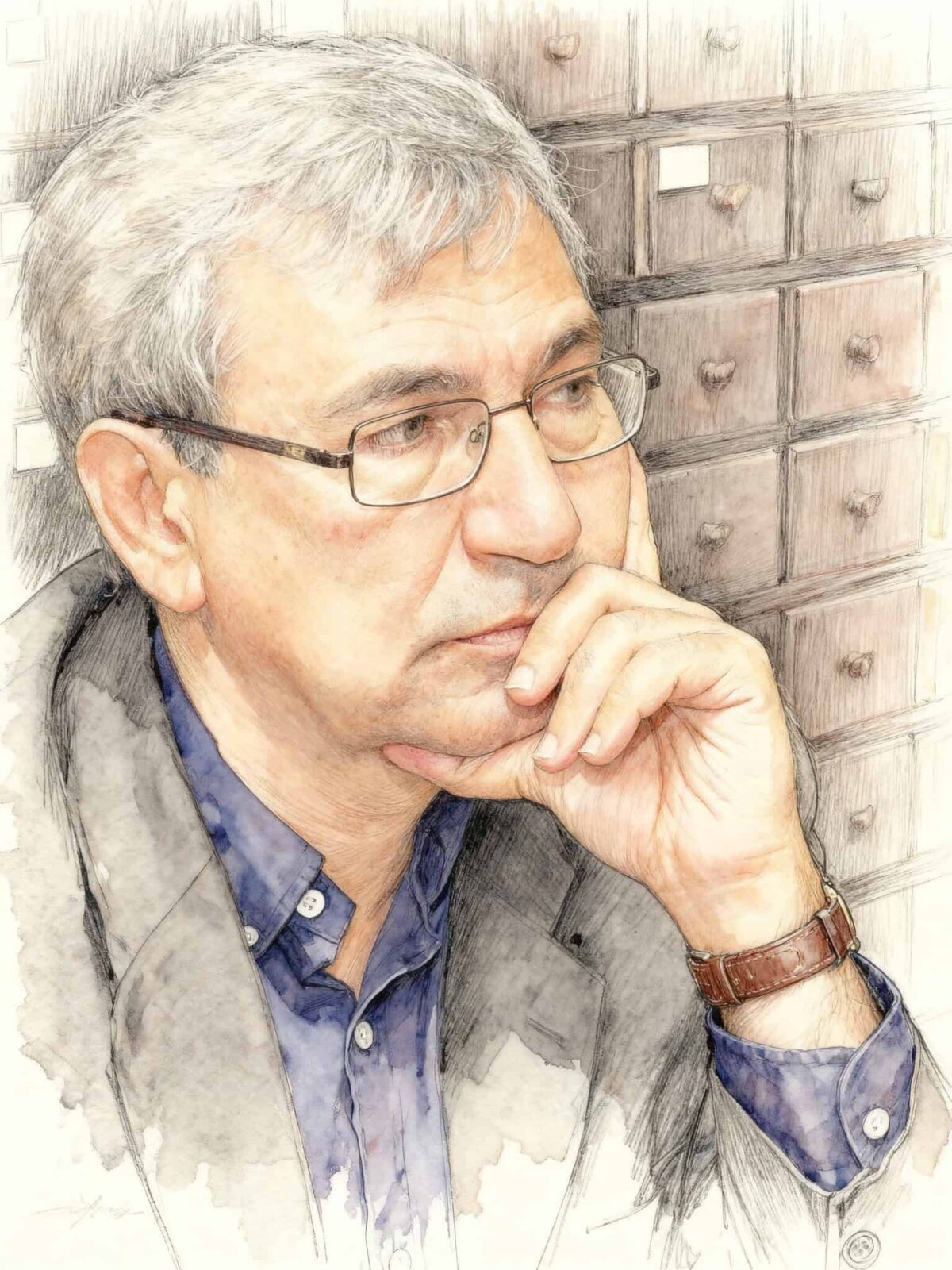
Illustration of Orhan Pamuk based on a photograph by Alexey Balakin, CC BY 3.0, via Wikimedia Commons.
