Rose Tremain signed first editions represent one of the quieter but more consistent opportunities in the British literary collecting market, and her standing has only grown with the honours that have accumulated over five decades of writing. A Dame, a Fellow of the Royal Society of Literature, and the winner of the Whitbread Novel Award, the Orange Prize, and the James Tait Black Memorial Prize, Tremain is an author whose critical reputation is entirely secure. First editions of Restoration (1989), her Booker-shortlisted breakthrough, and The Road Home (2007), her Orange Prize winner, attract the most collector attention, and early copies in fine condition are increasingly hard to find. With her work continuing to appear on prize lists, Rose Tremain signed first editions are among the most rewarding names in the market.

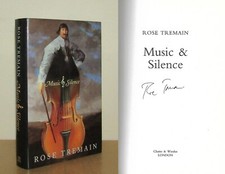
Rose Tremain - Music & Silence - Signed - 1st/1st (1999 First Edition DJ)
🇺🇸 Price: US $33.51
Buy It Now


SIGNED First. Rose Tremain. Absolutely & Forever. Hardback fine condition.
🇺🇸 Price: US $22.16
Buy It Now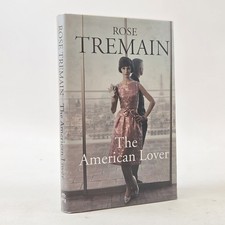


Rose Tremain - Music & Silence - Signed - 1st/1st (1999 First Edition DJ)
🇺🇸 Price: US $17.43
Buy It Now




Signed By Author is an eBay affiliate. We may earn a commission from qualifying purchases.
About Rose Tremain
Dame Rose Tremain was born Rosemary Jane Thomson on 2 August 1943 in London. Her father left the family when she was still a child, and she has spoken of beginning to write partly in response to that early rupture, an attempt to make sense of things through fiction that has never really stopped. She studied at the Sorbonne in Paris and the University of East Anglia, where she later taught creative writing from 1988 to 1995, and was appointed Chancellor in 2013. It was at UEA that she encountered the novelist Angus Wilson, whose encouragement helped persuade her to take her ambitions seriously.
She published her first novel, Sadler’s Birthday, in 1976, and was nominated as one of Granta’s 20 Best of Young British Novelists in 1983, a list that included Ian McEwan, Kazuo Ishiguro, Salman Rushdie, and Pat Barker. To be picked out in that company was a signal of considerable things to come.
It was her 1989 work, Restoration, which established her career. Set during the reign of Charles II, it follows the volatile fortunes of Robert Merivel, a physician drawn into the King’s inner circle and then cast back out of it, navigating a world of court intrigue, desire, and eventual reckoning. The novel was shortlisted for the Booker Prize and was later adapted for a film starring Robert Downey Jr. in 1995. A stage version followed in 2009, and Tremain returned to the character in a sequel, Merivel, published in 2012.
Sacred Country (1992) won the James Tait Black Memorial Prize and the Prix Femina Étranger in France. Music and Silence, set at the court of Christian IV of Denmark in the seventeenth century, won the Whitbread Novel of the Year Award in 1999, one of the most prestigious prizes in British fiction at the time. Each of these books demonstrated what had become a hallmark of her approach: meticulous historical research worn lightly, in the service of characters whose inner lives feel entirely real.
The Road Home (2007), which follows a widowed Eastern European migrant worker navigating contemporary London, won the Orange Broadband Prize for Fiction and the Costa Novel Award, and became her widest-selling book to date. It was a departure from the historical settings she is best known for, and showed the range of her sympathies. The Gustav Sonata (2016), set in Switzerland across the middle decades of the twentieth century, won the National Jewish Book Award and confirmed the sustained seriousness of her late career. Her most recent novel, Absolutely and Forever, was shortlisted for the Walter Scott Prize for Historical Fiction in 2024.
She was elected a Fellow of the Royal Society of Literature in 1983, appointed CBE in 2007, and made a Dame Commander of the Order of the British Empire in the 2020 New Year Honours for services to writing. Her books have been published in twenty-seven countries.
What marks Tremain out across a body of work now spanning five decades is a quality of inhabitation, a willingness to enter fully into other periods, other genders, other sensibilities, and to render them with psychological precision and quiet wit. Her historical fiction rarely announces itself as such. The past, in her hands, feels lived in rather than reconstructed, and the people who move through it feel like people rather than figures. She is, in the best sense, a novelist’s novelist, one whose influence on the writers who came after her is considerable and not always acknowledged as fully as it should be.
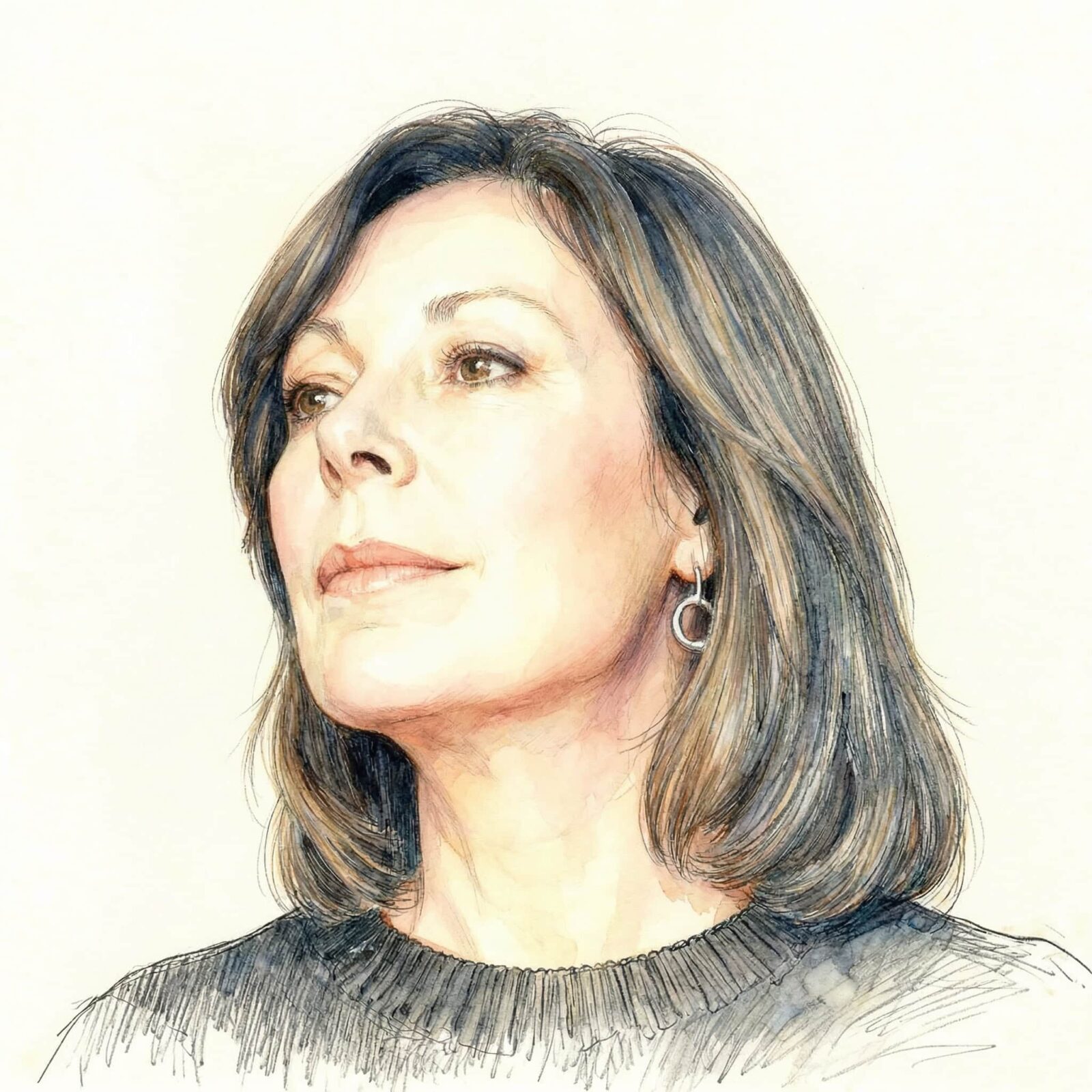
AI-generated illustration of Rose Tremain for editorial purposes; no endorsement implied.