Signed first editions of Shirley Jackson are among the most desirable books in modern horror collecting. The Haunting of Hill House (1959) is the obvious centrepiece, a National Book Award finalist and one of the defining haunted-house novels of the twentieth century. We Have Always Lived in the Castle (1962) is scarcely less important, and has become one of Jackson’s most admired works. Fine first editions, particularly with their original dust jackets, are genuinely scarce. Her influence on writers including Stephen King is well established, while the continuing stream of adaptations and new editions has brought Jackson’s work to a steadily expanding readership. For a serious horror collection, she is difficult to overlook.


The Haunting of Hill House ~ SIGNED by SHIRLEY JACKSON ~ First Edition ~ 1st
🇺🇸 Price: US $22,500.00
Buy It Now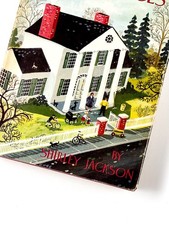
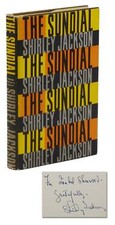
The Sundial ~ SIGNED by SHIRLEY JACKSON ~ First Edition ~ 1st Printing ~ 1958
🇺🇸 Price: US $4,500.00
Buy It Now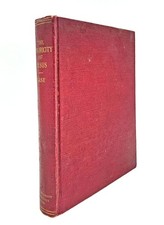
Shirley Jackson Case / The Historicity of Jesus Signed 1st Edition 1912
🇺🇸 Price: US $263.00
Buy It Now
Shirley Jackson / The Haunting of Hill House / Suntup Limited Edition / Signed
🇺🇸 Price: US $2,420.00
Buy It Now
HAUNTING OF HILL HOUSE Shirley Jackson Centipede Press SIGNED Numbered slipcased
🇺🇸 Price: US $1,040.00
Buy It NowSigned By Author is an eBay affiliate. We may earn a commission from qualifying purchases.
About Shirley Jackson
Shirley Jackson was born in San Francisco on 14 December 1916 and grew up for much of her childhood in the comfortable suburb of Burlingame. When she was a teenager, the family moved across the country to Rochester, New York. She went on to study at Syracuse University, where she published her first short story and met Stanley Edgar Hyman, the literary critic she would marry in 1940. They moved to New York City after their marriage and later settled in rural Vermont when Hyman took a teaching position at Bennington College. They had four children. Jackson’s life as a wife and mother would become a surprisingly rich source for her fiction, although she had a talent for turning the familiar into something decidedly less comfortable.
The story that changed everything was ‘The Lottery‘, published in The New Yorker in 1948. Readers were not pleased. The magazine received an extraordinary number of angry letters, and some subscribers apparently cancelled their subscriptions in protest. It is difficult now to imagine quite how startling the story must have seemed at the time, precisely because its setting is so ordinary. A small American community gathers for a familiar annual ritual, and only gradually does the reader realise what is happening. Jackson had found her territory: respectable people, ordinary houses, family life and the rather alarming things that can exist underneath all of them.
Jackson published six novels. The Haunting of Hill House (1959), a finalist for the National Book Award, is the obvious landmark and remains one of the finest haunted-house novels ever written. Jackson was less interested in conventional ghosts than in the possibility that the house, or the people inside it, might be creating the horror themselves. The novel has been adapted several times, most recently and famously as Netflix’s acclaimed 2018 series, which introduced Jackson’s work to a new generation.
Her final novel, We Have Always Lived in the Castle (1962), is arguably even more unsettling. Narrated by Merricat, a young woman living in isolation with her sister after a family tragedy, it is a strange mixture of fairy tale, murder story and domestic Gothic. Time named it one of the ten best novels of 1962, and it has since become a favourite with both critics and readers. Jackson had another, rather less sinister side, too. Her comic memoirs Life Among the Savages (1953) and Raising Demons (1957) drew on family life and became bestsellers. They are worth remembering, not least because they complicate the familiar image of Jackson as a writer who lived permanently in the shadows.
Her work was recognised during her lifetime, although perhaps not to the extent it deserved. In 1961 she won the Mystery Writers of America’s Edgar Award for her short story ‘Louisa, Please Come Home’, and she also received an O. Henry Award. By the early 1960s, however, her health was deteriorating. She smoked heavily and suffered increasingly severe anxiety, which at times made it difficult for her even to leave the house. Jackson died of cardiac arrest at her home in Bennington, Vermont, in 1965. She was just forty-eight.
Her standing has changed considerably since then. Jackson is now regarded as one of the essential American writers of the twentieth century and as a foundational figure in psychological horror. Her particular gift was not gore or spectacle but precision: she could take a house, a family, a village or a perfectly respectable dinner party and make it feel subtly, almost imperceptibly, wrong.
The Shirley Jackson Awards, established in 2007, now honour achievement in horror and dark fantasy, with past winners including Stephen King and Neil Gaiman. Both writers have acknowledged Jackson’s influence. Ruth Franklin’s major biography, published in 2016, brought further attention to Jackson’s life and work, and the renewed interest has continued. There is something pleasingly appropriate about it. Jackson’s books have never really dated; if anything, the ordinary world she wrote about has become more unsettling with time.
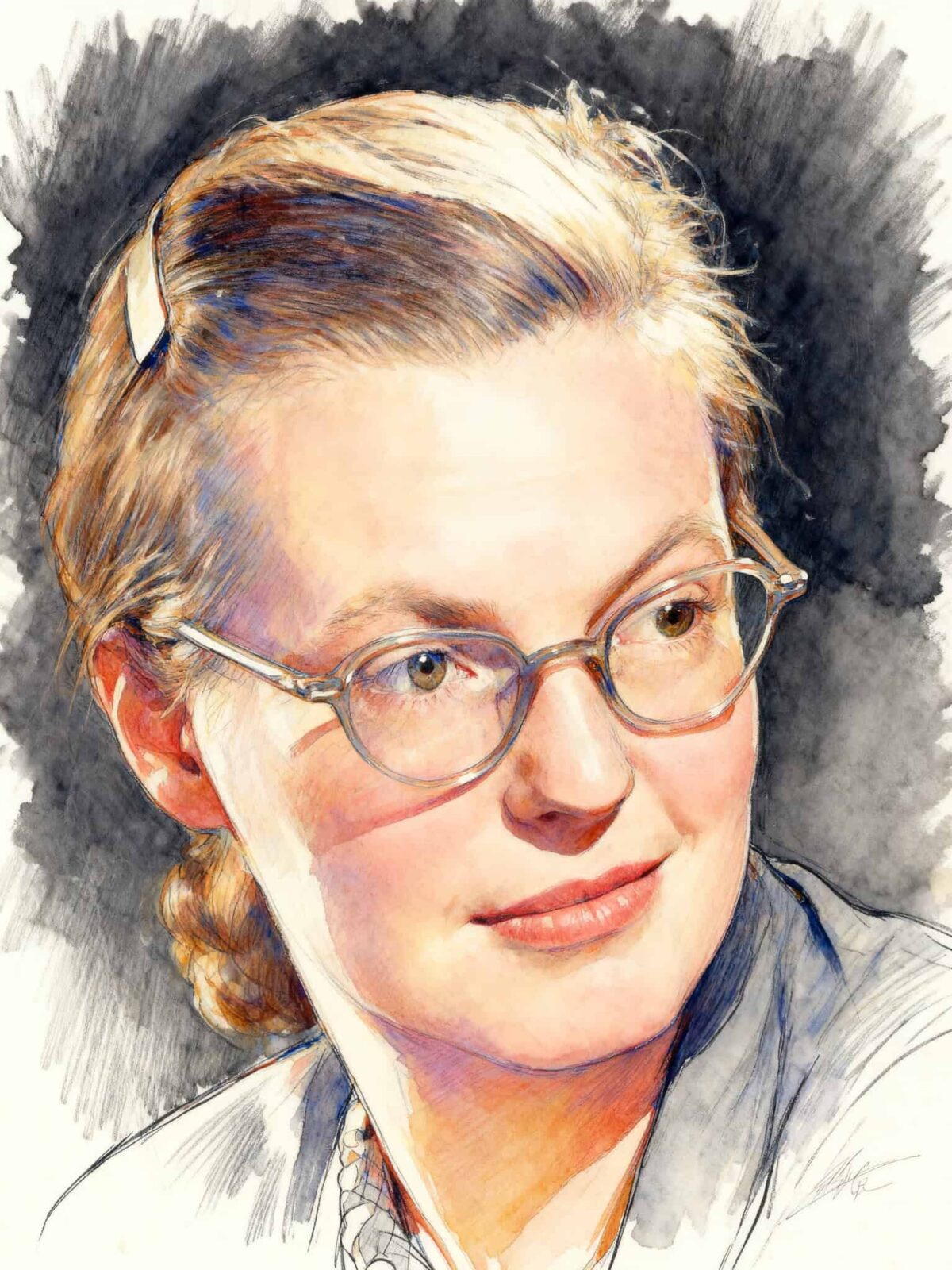
Illustration of Shirley Jackson based on a photograph by Eric Hartmann, Public domain, via Wikimedia Commons.
