

Amitav Ghosh signed first editions occupy a distinctive place in the literary fiction collecting market. Recipient of the Jnanpith Award, the Erasmus Prize, the Prix Médicis Étranger, and the Arthur C. Clarke Award, Ghosh is one of the most decorated and widely translated Indian writers of his generation, with a body of work that spans postcolonial fiction, historical saga, speculative narrative, and urgent non-fiction on climate and empire. The Shadow Lines (1988) and Sea of Poppies (2008) are the titles that attract the most collector interest, and signed copies of any of his books are genuinely scarce in the English-language market. For serious collectors building across literary fiction, signed copies of Amitav Ghosh are scarce, sought-after, and unlikely to become less so.



Amitav Ghosh SEA OF POPPIES-2008 RARE SIGNED 1ST ED HB/DJ SEA SAGA +ARC
🇺🇸 Price: US $58.00
Buy It Now

Amitav Ghosh / The Hungry Tide / Signed First UK Edition / HarperCollins 2004
🇺🇸 Price: US $138.00
Buy It Now

The Glass Palace / Amitav Ghosh / 1st/1st / Signed / Random House, 2001
🇺🇸 Price: US $33.75
Buy It Now
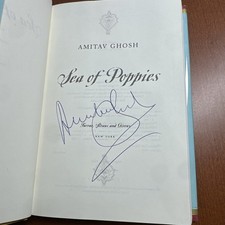
Amitav Ghosh SEA OF POPPIES-2008 RARE SIGNED 1ST ED HB/DJ SEA SAGA +ARC
🇺🇸 Price: US $24.99
Buy It Now



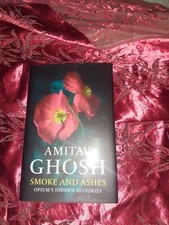
Smoke And Ashes By Amitav Ghosh Signed And Dated First Edition First Print
🇺🇸 Price: US $100.19
Buy It Now


Signed By Author is an eBay affiliate. We may earn a commission from qualifying purchases.
About Amitav Ghosh
Amitav Ghosh was born in Calcutta in July 1956 into a Bengali family with a diplomat father, which meant a childhood spent moving between India, Bangladesh, Sri Lanka, and Iran. That early experience of borders, displacement, and the porousness of national identity runs through virtually everything he has written since. He was educated at The Doon School in Dehradun, where his contemporaries included the novelist Vikram Seth and the historian Ramachandra Guha, and he later took degrees at the University of Delhi before completing a doctorate in social anthropology at Oxford. He worked for a time as a journalist at the Indian Express, taught at universities in Cairo, New York, and Harvard, and has written full-time since the mid-2000s.
His first novel, The Circle of Reason (1986), announced the arrival of a writer of unusual ambition and range, and won the Prix Médicis Étranger, one of France’s most prestigious literary awards. His second, The Shadow Lines (1988), set across Calcutta, Dhaka, and London, explored the violence of partition and the arbitrary cruelty of the borders that colonial history left behind. It won the Sahitya Akademi Award, India’s highest honour for literature, and the Ananda Puraskar, and remains one of the most studied novels in the postcolonial literary tradition. In an Antique Land (1992), a book that moves between medieval manuscript history and Ghosh’s own fieldwork in an Egyptian village, defies easy genre classification, blending travel writing, memoir, and historical research in a way that few writers had attempted before.
The Calcutta Chromosome (1996), an unsettling novel that reimagines the history of malaria research through a lens of conspiracy and alternative knowledge, won the Arthur C. Clarke Award. The Glass Palace (2000), a multigenerational saga sweeping from colonial Burma through the Second World War and beyond, was originally awarded the Commonwealth Writers’ Prize, which Ghosh declined, on principled grounds, citing his objections to the English-language requirement and the term Commonwealth itself. In 2004 he began the work that would become his most ambitious project: the Ibis trilogy, three novels tracing the human wreckage of the First Opium War and the trade that funded British imperial expansion. Sea of Poppies (2008), the first volume, was shortlisted for the Man Booker Prize. The trilogy, completed with River of Smoke (2011) and Flood of Fire (2015), sits within literary fiction but carries the scope and momentum of epic historical fiction.
In recent years Ghosh has turned increasingly to the climate crisis, both in fiction and non-fiction. The Great Derangement (2016), a work of essays, asks why literary culture has been so slow to reckon with ecological catastrophe. Gun Island (2019), The Nutmeg’s Curse (2021), and Smoke and Ashes (2023) have deepened that engagement. His latest novel, Ghost-Eye, published in India in late 2025 and the UK and US in 2026, returns to Calcutta and Brooklyn, exploring reincarnation, memory, and family across the decades.
The prizes have accumulated across four decades: the Padma Shri from the Government of India in 2007, the Jnanpith Award in 2018, making him the first English-language writer to receive India’s highest literary honour, and the Erasmus Prize in 2024, awarded specifically for his writing on climate change. In 2026 he was awarded a Guggenheim Fellowship. In 2019, Foreign Policy placed him among the most significant global thinkers of the decade. His books have been translated into more than thirty languages.
Illustration of Amitav Ghosh based on a photograph by Gage Skidmore, CC BY-SA 3.0, via Wikimedia Commons.
