
John Banville signed first editions occupy a distinctive place in the literary fiction collecting market, and serious collectors have been paying attention for some time. A Booker Prize winner, James Tait Black Memorial Prize recipient, and Franz Kafka Prize laureate, Banville is one of the most decorated Irish writers of his generation and a perennial Nobel name. The early novels are the prime targets: first editions of The Sea (2005) and The Book of Evidence (1989) attract strong collector interest, and signed copies of either in fine condition are increasingly hard to find. With Venetian Vespers longlisted for the 2026 Walter Scott Prize for Historical Fiction, his profile is only growing. For collectors focused on enduring literary value, John Banville signed first editions are among the most rewarding names in the market

John Banville - THE BOOK OF EVIDENCE - Signed First Edition, First Printing
🇺🇸 Price: US $150.00
Buy It Now


Newton Letter: An Interlude Signed UK First Edition By Banville, John
🇺🇸 Price: US $200.00
Buy It Now
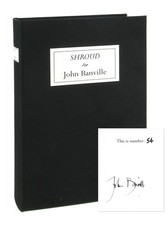


Signed By Author is an eBay affiliate. We may earn a commission from qualifying purchases.
About John Banville
John Banville was born on 8 December 1945 in Wexford, on the south-east coast of Ireland, and grew up in a town he has described as culturally remote but rich in the kind of quiet, observant solitude that shapes a certain kind of writer. He read voraciously from childhood, later citing James Joyce’s Dubliners as the book that taught him fiction could address the deepest questions of existence. He worked for Aer Lingus in his early twenties, which took him across Europe, before settling into journalism, first at the Irish Press, where he spent over a decade, and then as literary editor of the Irish Times from 1988 to 1999. It was not a conventional path to literary fiction, but it gave him an editor’s eye and a journalist’s discipline.
His first book, a story collection, appeared in 1970, and his debut novel Nightspawn followed a year later. Neither made much noise. What announced him properly was Birchwood (1973), a formally strange, darkly comic Gothic novel set in the Irish countryside, and then the Revolutions Trilogy, published between 1976 and 1982: Doctor Copernicus, Kepler, and The Newton Letter, three novels built around the lives of European scientists that won him the James Tait Black Memorial Prize and a growing reputation as one of the most serious stylists writing in English. The comparisons to Nabokov began to circulate; Banville himself preferred to cite Henry James and W.B. Yeats.
The novel that brought him closest to the mainstream was The Book of Evidence (1989), a first-person confession of a motiveless murder by a chilling, unreliable narrator, which was shortlisted for the Booker Prize. Then came the Frames Trilogy, three linked novels meditating on art, identity, and self-deception: Ghosts, Athena, and eventually the work that completed the picture. His reputation as a demanding but essential voice in literary fiction was well established by the time The Sea appeared in 2005. It won the Booker Prize, in a judges’ vote reportedly decided by the casting vote of the chair, and though the choice was called perverse in some quarters, time has been kind to it. The novel, a quiet, luminous account of grief and buried memory, is now considered among the finest Irish novels of its era.
The awards have accumulated steadily. The Franz Kafka Prize in 2011, the Prince of Asturias Award for Literature in 2014, the Austrian State Prize for European Literature, a Fellowship of the Royal Society of Literature, an Italian knighthood. He is regularly named as a Nobel contender, which in literary circles is a way of saying that his work is considered permanently important.
In parallel with his literary output, Banville has long maintained a second identity as a crime writer under the pseudonym Benjamin Black. The Quirke novels, a series of crime thrillers set in 1950s Dublin, began with Christine Falls (2006) and ran to eight installments, the last published under his own name. A second crime series featuring the Irish detective Strafford began with Snow (2020) and has attracted a new generation of readers. Both series have been shortlisted for the CWA Historical Dagger.
His most recent literary novel, Venetian Vespers (2025), a late Victorian tale of an English journalist on a cursed honeymoon in Venice, was longlisted for the 2026 Walter Scott Prize for Historical Fiction, adding a new dimension to a career that has never stood still. Now in his eighties, Banville continues to write with the same exacting attention to language that has always defined him, and his standing as one of the great prose stylists of his generation shows no sign of being revised downward.
Illustration of John Banville based on a photograph by Jind?ich Nosek (NoJin), CC BY-SA 4.0, via Wikimedia Commons.
_III.jpg)