Farley Mowat signed first editions are among the more rewarding items to track down in the Canadian and British natural history collecting market. Never Cry Wolf (1963) and People of the Deer (1952) are the prime targets, both seminal books and both genuinely scarce in signed first edition form. Mowat’s reputation has only solidified since his death in 2014, and with environmental concerns keeping his work current, the readership for his books is not shrinking. The 1983 Disney film adaptation of Never Cry Wolf introduced him to successive generations, and continues to do so. For collectors looking beyond the obvious names, Farley Mowat signed first editions represent a well-grounded acquisition in a writer whose importance is now firmly settled.
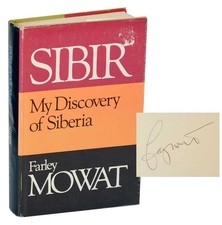

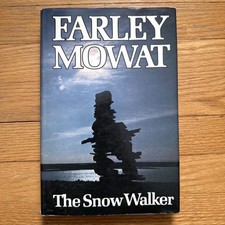


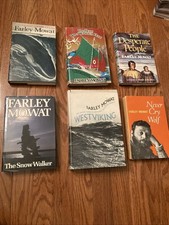


Farley Mowat "A whale for the killing" SIGNED 1st edition HCDJ 1972 Canada
🇺🇸 Price: US $54.58
Buy It Now




Signed By Author is an eBay affiliate. We may earn a commission from qualifying purchases.
About Farley Mowat
Farley Mowat was born in Belleville, Ontario, in 1921, the son of a librarian father who moved the family frequently across the Canadian prairies. Those early years, spent in Saskatoon and around the wide open spaces of the west, gave him something that would never quite leave him: a feeling for wild places and for the animals that inhabited them, at a time when the relationship between humans and the natural world was still a good deal less complicated than it would later become.
He served in the Second World War as an infantry officer, seeing action in Sicily and Italy, and the experience marked him permanently. The war left him with a deep suspicion of institutions, a distrust of official narratives, and a restlessness that eventually drove him north. In 1947 he travelled to the Keewatin Barrenlands of the central Arctic to study wolves for the Dominion Wildlife Service. The trip lasted two years. It changed everything.
Never Cry Wolf, published in 1963, drew on those years in the Arctic and turned received wisdom about wolves entirely on its head. Where the official line held that wolves were a menace to caribou herds and ought to be controlled accordingly, Mowat argued the opposite, with wit, anger, and close observation. The book became an international bestseller, was translated into dozens of languages, and is widely credited with shifting public attitudes towards wolf conservation in North America. It remains one of the most influential works of natural history & conservation published in the twentieth century.
But Never Cry Wolf was far from his only contribution. People of the Deer (1952), his first major book, had already caused a storm by documenting the near-extinction of the Ihalmiut, an Inuit people of the interior Barrens, and placing the blame squarely on government neglect. The book was attacked by the Canadian government, disputed, and eventually vindicated. It set the pattern for much of what followed: Mowat doing the fieldwork, telling the story plainly, and then watching the authorities try to discredit him.
A Whale for the Killing (1972) chronicled the harpooning of a fin whale trapped in a Newfoundland lagoon and the community’s failure to save it, and helped accelerate the nascent anti-whaling movement. Sea of Slaughter (1984), perhaps his most exhaustive work, catalogued four centuries of ecological destruction along the Atlantic seaboard, and is still cited by marine biologists and environmentalists. Alongside these, he wrote memoirs, histories, and a string of books for younger readers, including the beloved Lost in the Barrens (1956), which introduced a generation of Canadian children to the idea that the north was a place worth knowing.
Never Cry Wolf was adapted for cinema in 1983 by Carroll Ballard, produced by Walt Disney Pictures, and received warmly by critics. The film introduced Mowat’s work to a much wider audience and has never really dated.
The awards were considerable. He received the Governor General’s Literary Award, Canada’s most prestigious literary honour, and the Gemini Award, among others. In 1981 he was made an Officer of the Order of Canada. His books sold in excess of seventeen million copies worldwide, a figure that very few Canadian writers of any era have approached.
He was not without controversy. His methods were questioned, his facts occasionally disputed, and he was famously banned from entering the United States in 1985 on grounds that were never fully explained and were widely suspected to be connected to his outspoken politics. He took it in good humour. In later life he lived on Cape Breton Island, Nova Scotia, and continued writing into his eighties.
Mowat died in May 2014, at ninety-three. He left behind more than forty books and a legacy that sits at the intersection of literature, conservation, and advocacy, a combination that was rare in his time and remains rare now. For readers who came to him through Never Cry Wolf, or through any of the northern books, he offered something that is hard to find: a writer who genuinely knew the places he was writing about, and cared about them beyond the reach of fashion or career.
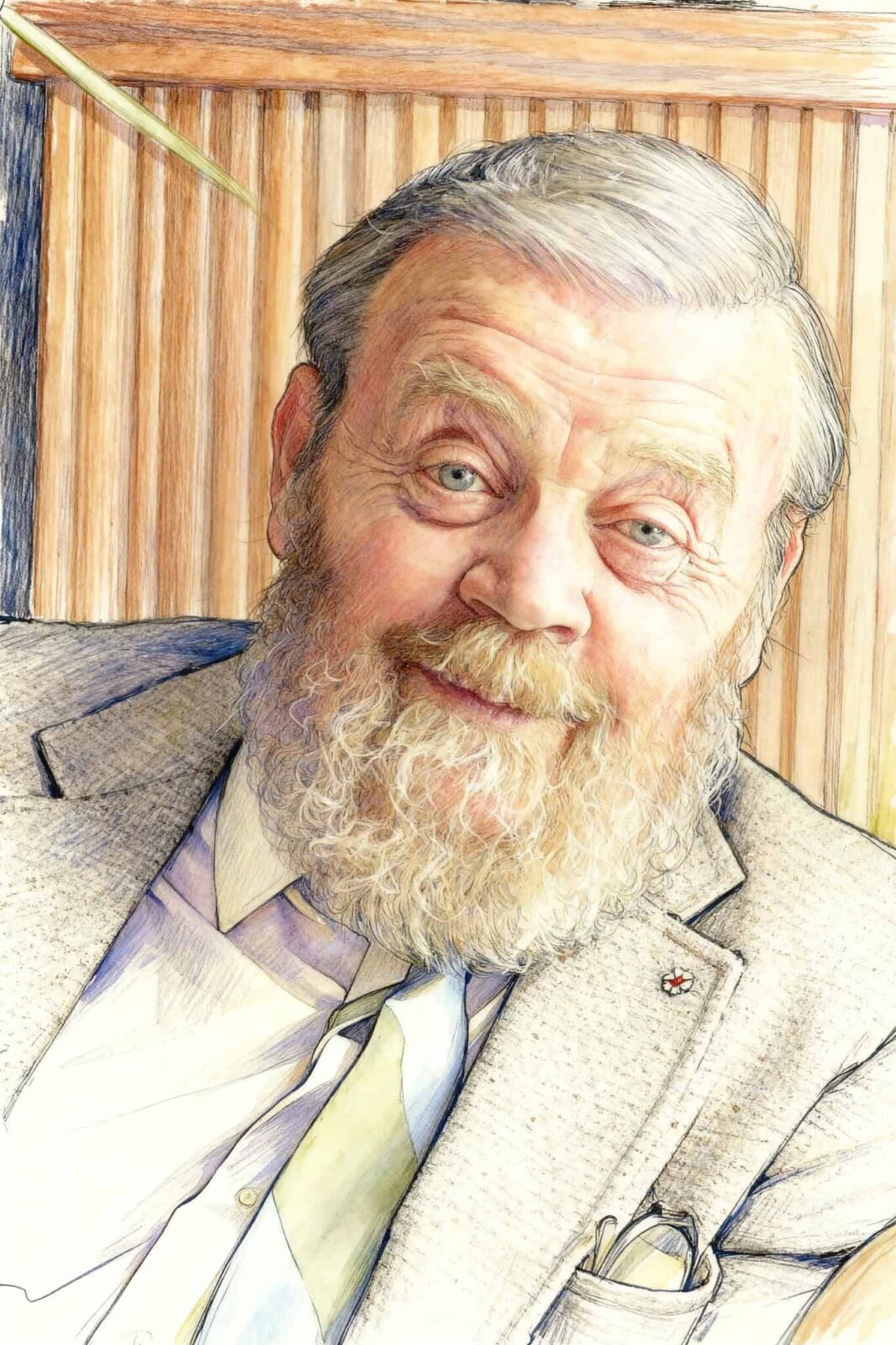
Illustration of Farley Mowat based on a photograph by Belleville Intelligencer, CC0, via Wikimedia Commons.
