Anne Carson signed first editions have long interested serious collectors of contemporary poetry, and her 2026 Nobel Prize in Literature has sharpened that interest considerably. Carson’s hybrid, genre-defying books, from Autobiography of Red (1998) to the extraordinary Nox (2010), are prized as much for their unconventional physical forms as for the writing itself, and early signed copies were never plentiful to begin with. With a Nobel now attached to her name, her backlist is likely to see renewed demand and tightening supply. For collectors building a serious poetry collection, Carson belongs on the list.

*SIGNED* Anne Carson If Not Winter Sappho, 2002, Hardcover - 1st ed/ 2nd print
🇺🇸 Price: US $350.70
Buy It Now

Anne Carson / PLAINWATER initialed 1ST ED inscribed to her lover's next gf!
🇺🇸 Price: US $2,000.00
Buy It NowSigned By Author is an eBay affiliate. We may earn a commission from qualifying purchases.
About Anne Carson
Anne Carson was born in Toronto in 1950 and spent her childhood moving between small towns in Ontario, where her father worked as a banker. Her interest in the ancient world began at school, when a Latin teacher started tutoring her in ancient Greek during lunch breaks. It was an encounter that would shape her life’s work. Carson studied classics at the University of Toronto, completing her BA, MA and PhD, with a period at the University of St Andrews along the way. Her close study of Sappho and the Greek tragedians has remained a defining influence, even in writing that bears little resemblance to traditional classical scholarship.
For much of her career, Carson has taught classics and comparative literature at universities in Canada and the United States, including McGill, Princeton, Emory and the University of Michigan. Her reputation, however, extends well beyond academia. As a poet, essayist and translator, she has consistently resisted easy classification. Collections such as Glass, Irony and God (1995) and Plainwater (2000) bring together poetry, prose, classical learning and autobiography, often within the same work. Few writers move so freely between these forms, or make such apparently unlikely combinations feel quite so natural.
Her best-known book is probably Autobiography of Red (1998), a novel in verse that recasts the Greek myth of Geryon as the story of a boy falling in love. The red-winged monster of antiquity becomes a recognisably human figure, and Carson’s retelling brought her work to readers well beyond the academic and poetry worlds. Nox (2010) is another landmark, a folded, accordion-style book created as an elegy for her estranged brother. Combining photographs, fragments and a translation of a poem by Catullus, it is as much a physical work of art as a collection of poetry. Her translation of Sappho’s surviving fragments, If Not, Winter (2002), is equally important, preserving the gaps and uncertainties of the original Greek rather than smoothing them over.
Carson’s honours have accumulated over four decades. In 2001, she became the first woman to win the T.S. Eliot Prize for Poetry, for The Beauty of the Husband. She has also won the Griffin Poetry Prize twice, in 2001 and 2013, the latter for Red Doc>. Among her other distinctions are a MacArthur Fellowship, a Guggenheim Fellowship, a Lannan Literary Award, Canada’s Governor General’s Award and the Princess of Asturias Award for Literature. In October 2026, she was awarded the Nobel Prize in Literature, recognised by the Swedish Academy for a bold and inventive body of work in playful dialogue with the classical tradition. She became only the 19th woman to receive the prize.
Poetry may be the natural starting point for Carson’s work, but it hardly tells the whole story. She has written librettos, collaborated with artist Robert Currie on handmade books and installations, and worked on performance projects with musicians including Lou Reed and Laurie Anderson. Her collection Wrong Norma, published in 2024, received strong reviews and showed that her appetite for formal experimentation remains undiminished. In 2022, she took Icelandic citizenship, an intriguing detail in the life of a writer who has always seemed somewhat detached from conventional ideas of literary category and national identity.
What sets Carson apart is the seriousness with which she approaches the act of reading, and the connections she finds between texts that might at first seem worlds apart. Sappho and Virginia Woolf, Catullus and Hollywood can all occupy the same page, not as clever decoration but because Carson finds genuine points of contact between them. Her work can be demanding, but it also invites readers to make discoveries of their own. Few contemporary poets have created a body of work quite so distinctive, or made such challenging experiments so rewarding to follow.
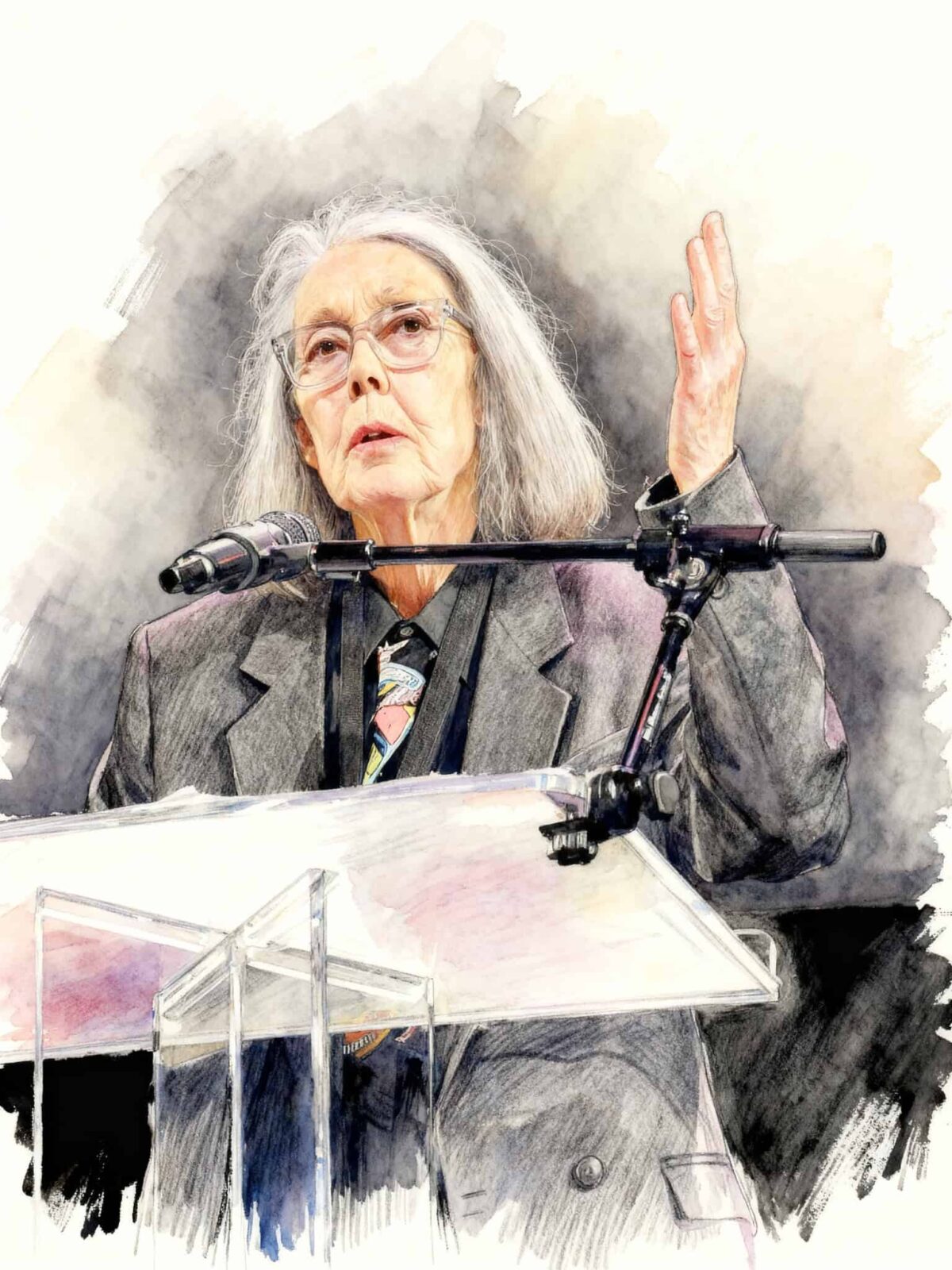
Illustration of Anne Carson based on a photograph by Jay Dixit, CC BY-SA 4.0, via Wikimedia Commons.
