Signed Graham Greene first editions are among the most sought-after items in the twentieth-century literary collecting market, and genuinely scarce. Greene died in 1991 and signed selectively in his later years, which means authenticated copies command serious attention. His spy novels, Our Man in Havana (1958) and The Quiet American (1955), are particularly desirable, combining literary prestige with enduring cultural relevance. A Nobel Prize shortlistee, James Tait Black winner, and holder of the Order of Merit, Greene occupies a position at the very top of the canon. For collectors focused on long-term value, this is among the most rewarding names in the market.

Graham Greene Signed Limited Edition: A Quick Look Behind (1983, #229 Of 330)
🇺🇸 Price: US $194.28
Buy It Now
Graham Greene Signed Limited Edition How Father Quixote Became a Monsignor
🇺🇸 Price: US $300.00
Buy It Now
Graham Greene / Reflections on Travels with My Aunt Signed 1st Edition 1989
🇺🇸 Price: US $201.25
Buy It Now

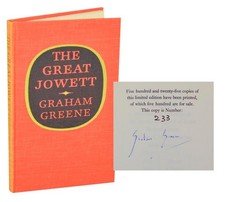

Graham GREENE / HOW FATHER QUIXOTE BECAME A MONSIGNOR Signed Limited #207354
🇺🇸 Price: US $172.50
Buy It Now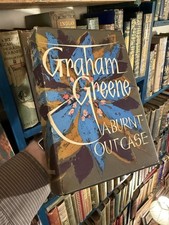

Our Man in Havana by GRAHAM GREENE ~ SIGNED First Edition 1958 ~ Spy Novel 1st
🇺🇸 Price: US $8,000.00
Buy It Now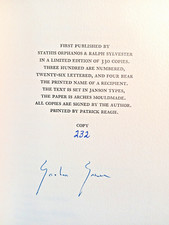
Graham Greene (Signed, Limited) A QUICK LOOK BEHIND (1983) Mint, Unread Copy
🇺🇸 Price: US $149.00
Buy It Now
1985 GRAHAM GREENE, THE TENTH MAN, FICTION, SIGNED, 1st Edition, DUST JACKET
🇺🇸 Price: US $165.44
Buy It Now
Graham Greene Signed 1983 A Quick Look Behind Footnotes to an Autobiography
🇺🇸 Price: US $300.00
Buy It Now

May We Borrow Your Husband?-Graham Greene-SIGNED-LIMITED-Excellent condition!
🇺🇸 Price: US $215.00
Buy It Now

Signed #694/750 GRAHAM GREENE. Yes and No and For Whom the Bell Chimes. Ltd.
🇺🇸 Price: US $285.00
Buy It Now
Signed By Author is an eBay affiliate. We may earn a commission from qualifying purchases.
About Graham Greene
Graham Greene was born in 1904 in Berkhamsted, Hertfordshire, where his father was headmaster of the local school. It was, by his own account, an unhappy childhood, marked by bullying and episodes of serious depression that led, in his teens, to what he later described as several attempts on his own life. He studied history at Balliol College, Oxford, converted to Catholicism in 1926, and went on to work as a journalist and sub-editor at The Times before fiction took over entirely. The combination of Catholic conscience, journalistic eye, and a genuine appetite for dangerous places produced one of the most distinctive bodies of work in twentieth-century literature.
He divided his output deliberately, if not always convincingly, between what he considered serious novels and what he called his ‘entertainments’, a term he applied to his thrillers and spy novels. The first of the entertainments was Stamboul Train (1932), spare and suspenseful, and the first of his many novels to be filmed. What followed was a run of espionage and thriller fiction that established his reputation on both sides of the Atlantic: A Gun for Sale (1936), The Confidential Agent (1939), The Ministry of Fear (1943), each one deploying the seedy, morally compromised atmosphere that became his signature. The label ‘”‘entertainment'”‘ was always a mild misdirection. These books were doing serious work under the surface, and Greene knew it.
His actual intelligence career deepened the fiction considerably. During the Second World War he worked for MI6, recruited by his sister, and was stationed in Sierra Leone before being posted to London, where his section head was Kim Philby, the Cambridge spy who was later revealed as a Soviet double agent. Greene remained loyal to Philby even after the exposure, writing the introduction to his 1968 memoir, asking ‘who among us has not committed treason to something or someone more important than a country?’ That moral ambivalence, the refusal to draw clean lines between loyalty and betrayal, runs through his spy fiction like a fault line.
The Quiet American (1955), set in Vietnam during the First Indochina War, follows a cynical British journalist and an idealistic young American, and functions as a searing critique of American foreign policy as much as a spy novel. It was prescient in ways that later readers found uncomfortable. Our Man in Havana (1958) went the other direction entirely, a brilliant comic novel in which a vacuum cleaner salesman recruited by MI6 simply fabricates his intelligence reports, with darkly farcical consequences. The Human Factor (1978), his last major espionage novel, returned to the territory of Philby, tracing a mole inside British intelligence with compassion rather than condemnation.
The distinction between his literary fiction and his spy novels matters less than Greene pretended. The Power and the Glory won the 1941 Hawthornden Prize, The Heart of the Matter won the 1948 James Tait Black Memorial Prize, and Greene was shortlisted for the Nobel Prize in Literature multiple times. He received the Order of Merit in 1986, one of Britain’s most prestigious honours. His Third Man screenplay for Carol Reed’s 1949 film, starring Orson Welles, is as good as anything he wrote in any form. Those wanting to explore his wider work will find natural connections to literary fiction and, in his Catholic novels especially, to some of the most serious writing of the postwar period.
The Third Man, Our Man in Havana, and The Quiet American have all been adapted for film, keeping his name in front of audiences well beyond the literary readership. Greene died in Vevey, Switzerland, in April 1991. His books have never been out of print, and his reputation has not dimmed. If anything, the moral complexity that once divided critics now looks like the thing that ensures his survival.
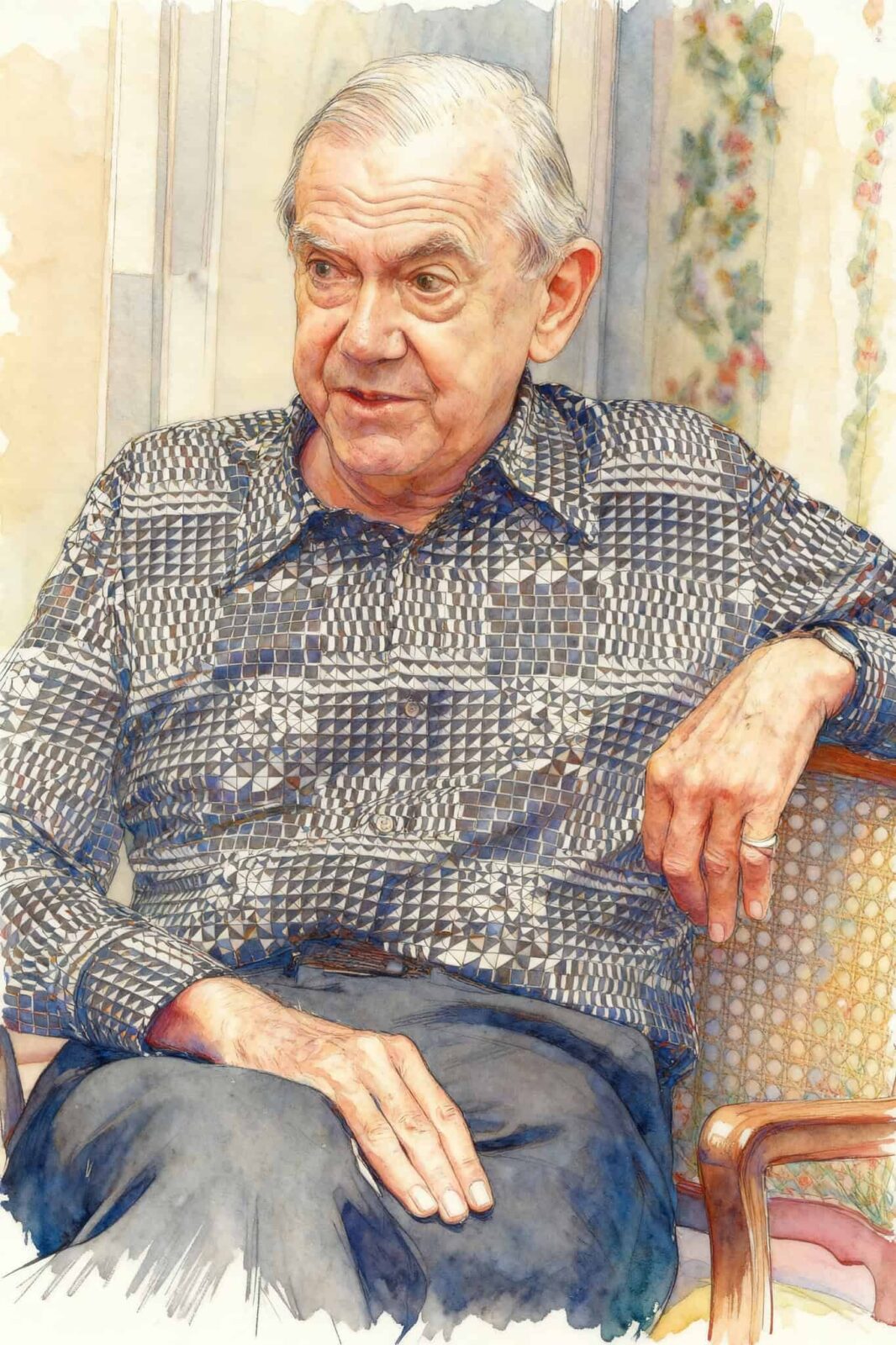
Illustration of Graham Greene based on a photograph: FOTO:FORTEPAN / Magyar Hírek folyóirat, CC BY-SA 3.0, via Wikimedia Commons
