

The IPCRESS File and the Bernard Samson trilogy are the prime targets for collectors of Len Deighton signed first editions, and with his death in March 2026, scarcity has sharpened overnight. Deighton effectively retired in the mid-1990s and signed relatively little in his later years, which means genuinely signed copies of his early work are harder to find than many collectors realise. His standing in spy novels is unassailable, with comparisons to le Carré and Graham Greene that are not merely journalistic flattery. For those building a serious collection in the genre, Deighton is a name every collector should know.
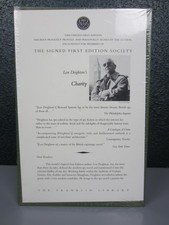
CHARITY - Len Deighton - Franklin Library Signed First Edition - Leather
🇺🇸 Price: US $45.00
Buy It Now
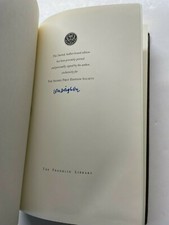





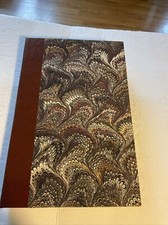

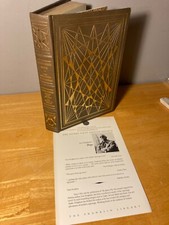

Len Deighton: Funeral In Berlin: SIGNED First Edition 1st/1st Wrap-Around Band
🇺🇸 Price: US $992.63
Buy It Now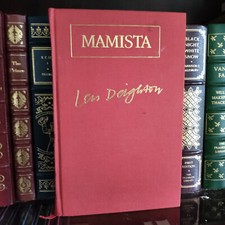

Len Deighton: The IPCRESS File - SIGNED First Edition 1st / 1st - Hbk Dw 1962
🇺🇸 Price: US $496.31
Buy It Now
SIGNED Len Deighton Hope Franklin Library leather bound first edition
🇺🇸 Price: US $35.00
Buy It Now

Signed By Author is an eBay affiliate. We may earn a commission from qualifying purchases.
About Len Deighton
Len Deighton was born in 1929 to a working-class family in a wealthy part of London, his father a chauffeur, his mother a part-time cook. That gap between the world he grew up in and the world around him gave him an eye for the absurdities of British class that would run through everything he wrote. Before fiction took hold, his life was genuinely varied: he served in the Royal Air Force as part of Britain’s then-mandatory national service, studied art, and worked as a waiter, pastry chef, and flight attendant before finding success as a book and magazine illustrator. His designs included the first UK edition of Jack Kerouac’s On the Road in 1958.
His first novel, The IPCRESS File, helped set the tone of cool and gritty 1960s spy novels when it appeared in 1962. The unnamed protagonist — sardonic, working-class, possessed of a genuine interest in good food — was a deliberate rebuke to the genre’s prevailing glamour. Deighton reportedly had never read a James Bond novel, but The IPCRESS File was published the same month Dr. No hit cinemas, and the contrast was stark and useful. Where Fleming offered polish, Deighton offered grime: no glamour, no clean victories, moral ambiguity, bureaucratic constraints, institutional dysfunction. The book was a bestseller, and the spy novels that came next, Horse Under Water (1963) and Funeral in Berlin (1964), confirmed that he hadn’t simply got lucky first time out.
Funeral in Berlin stayed on the New York Times bestseller list for twenty weeks and sold over forty thousand copies in hardback in 1965. The film adaptations that followed brought Michael Caine to international attention and embedded the Deighton protagonist — renamed Harry Palmer for the screen — in popular culture. The three films, The IPCRESS File (1965), Funeral in Berlin (1966), and Billion Dollar Brain (1967), were a genuine cultural moment, and Caine later credited writers like Deighton with giving him his career.
Deighton published prolifically across the 1960s and 1970s, but his most sustained achievement came with the Bernard Samson novels. Berlin Game, published in 1983, was the first of ten novels featuring the smart, cynical MI6 officer Bernard Samson, and along with Mexico Set and London Match it was adapted into the 1988 TV series Game, Set and Match. The trilogy, and the further trilogies that followed, gave him room to do something he genuinely excelled at: building a world with its own bureaucratic logic, its betrayals compounding slowly across hundreds of pages, the Cold War rendered as a place of perpetual compromise rather than heroic action.
He was not solely a spy writer. His 1970 novel Bomber was listed in Anthony Burgess’s 1984 work Ninety-Nine Novels as one of the 99 best novels in English since 1939 — a work of military fiction rather than espionage, and one that demonstrated the range of what he could do with historical research and narrative structure. His non-fiction was similarly broad, taking in military history and a well-regarded book on the assassination of President Kennedy. For those exploring his work beyond the spy genre, his historical fiction and military writing offer a natural bridge.
Between 1962 and 1966 Deighton was also food correspondent for The Observer and drew cookstrips — graphic recipes with a limited number of words. A selection was published in 1965 as Len Deighton’s Action Cook Book, the first of five cookery books he wrote, aimed at men at a time when that was a genuinely novel idea. He was, unusually, a bestselling author in two genres simultaneously.
He simply appeared to switch off his word processor and, without fanfare, retire in the mid-1990s, after the final Bernard Samson novel. He spent his later years in Guernsey, out of the spotlight, and died there on 15 March 2026 at the age of ninety-seven. His literary agent Tim Bates described him as a titan, not just of spy fiction but of twentieth-century writing in any genre. The books have never been out of print. They don’t need a new adaptation or a critical reassessment to justify their place in the canon. They earned it a long time ago.
AI-generated illustration for editorial purposes; no endorsement implied.