The BBC’s acclaimed new adaptation is introducing William Golding’s greatest novel to a generation that has never read it. For those coming to it fresh, and for those returning, the question is always the same: how did one book get so much so right?
A book born from despair
William Golding was not an optimist. By the time he sat down to write Lord of the Flies in the early 1950s, he had served in the Royal Navy, taken part in the D-Day landings, and spent the years since the war teaching schoolboys in Salisbury while trying, and failing, to get a novel published. The world had shown him what it was capable of. He did not forget.
The book that became Lord of the Flies was rejected by more than twenty publishers before Victor Gollancz accepted it in 1954. One reader’s report called it “absurd and uninteresting”. Another dismissed it outright. The editor who finally championed it, Charles Monteith at Faber & Faber – who would go on to publish it in paperback – recognised something the others had missed: that this was not really a boys’ adventure story at all. It was a philosophical fable, and a savage one.
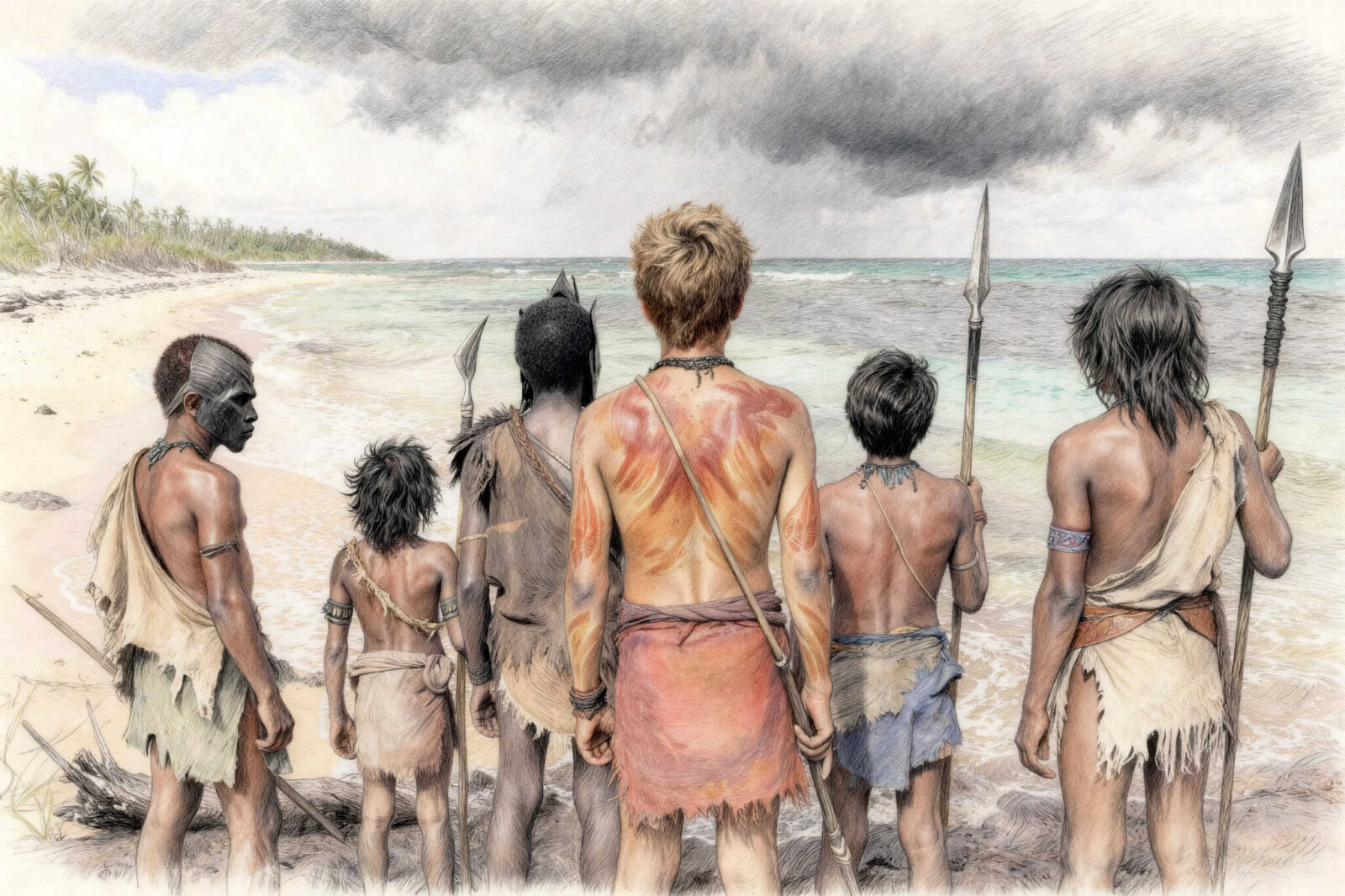
The setup is deceptively simple. A group of British schoolboys, evacuated during a nuclear war, are stranded on an uninhabited tropical island. There are no adults. There is plenty of food and fresh water. For a moment, it seems like it might go well. It does not go well.
Golding was writing in explicit response to R.M. Ballantyne’s The Coral Island (1857), a Victorian boys’ adventure in which shipwrecked English lads behave impeccably and triumph over savagery through Christian virtue and imperial pluck. Golding thought this was nonsense. His boys, given the same circumstances, destroy themselves. The savagery, he argued, was not out there on the island. It was inside them from the start. It is inside all of us.
Why the new BBC adaptation matters
The novel has been filmed before – Peter Brook’s stark black-and-white version in 1963 remains the most admired, and the 1990 Hollywood adaptation is largely best forgotten – but the new BBC production has arrived at a cultural moment that gives the story a particular charge. Written by Jack Thorne and directed by Marc Munden, the series was produced for BBC iPlayer and BBC One in a co-production with the Australian streamer Stan. Streaming audiences, accustomed to prestige television that takes ideas seriously, have responded strongly. The production’s visual language and its willingness to sit with the horror of what the novel describes have earned it considerable critical praise.
What the best screen adaptations of Golding’s novel have always understood is that the book is not a horror story about exceptional children. It is a horror story about ordinary ones. Ralph, Piggy, Jack, Simon: these are recognisable types, not monsters. The process by which they become capable of murder is gradual, credible, and deeply uncomfortable, because Golding is at every point insisting that you see yourself in them.
The BBC production handles the symbolic architecture of the novel with particular care: the conch as the fragile emblem of democratic order, the signal fire as the tension between hope and appetite, Piggy’s spectacles as the light of reason that the group progressively destroys. Golding was a meticulous craftsman, and the book rewards that kind of attention.
The enduring power of a dark idea
Lord of the Flies was awarded the Nobel Prize in Literature in 1983 – the Nobel committee citing Golding’s novels as illuminating “the human condition in the world of today”. The book has never been out of print. It has been translated into dozens of languages and has sold tens of millions of copies. For decades it was a fixture on school syllabuses in Britain and America, which gave it an unusual double life: required reading that people actually returned to voluntarily as adults, often finding it more disturbing the second time.
Part of its power is structural. The island is a laboratory, stripped of the usual excuses: no poverty, no prior grievance, no ideology to blame. What remains is the question Golding is really asking – whether civilisation is something we carry within us or something imposed on us from outside. His answer is deeply uncomfortable: it is largely the latter, and it is considerably more fragile than we like to think.
The novel’s reputation has occasionally attracted the sort of revisionism that attaches to canonical texts. In 2020, a widely shared article cited a real-life case of six Tongan boys shipwrecked on a Pacific island in 1966, who reportedly cooperated rather than turned on one another, as evidence that Golding was wrong. But Golding’s argument was never that cooperation is impossible – Ralph and Piggy cooperate throughout, and it gets them almost nowhere. His argument was about what happens when social order fails and fear fills the space it leaves. That argument has not dated.
William Golding: The collector’s view
For collectors, Golding occupies a position that is both well-established and still undervalued relative to his literary stature. He is a Nobel laureate whose first novel is one of the defining books of the twentieth century – and yet signed first editions of Lord of the Flies, published by Faber & Faber in 1954, remain genuinely attainable by the standards of comparable literary landmarks.
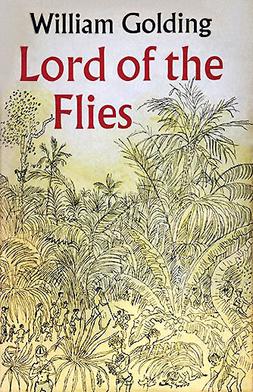
The first edition in the original cream dust jacket – with its now-iconic design – is the prime target, and copies in fine condition are scarce. The print run was modest, the book was not an immediate commercial success, and surviving copies in collectible condition with unclipped jackets represent a genuinely small pool of material. Signed copies from the first printing are rarer still: Golding was not a prolific signer, and he died in 1993.
The Nobel Prize in 1983 gave his market a significant uplift, and the ongoing presence of Lord of the Flies on reading lists, combined with the renewed public interest generated by major adaptations, has kept demand consistent. Among later works, Pincher Martin (1956) and The Inheritors (1955) attract serious collector attention, and signed copies of his later fiction – The Spire (1964) especially – are considerably more achievable for those entering the market.
The BBC adaptation is bringing a generation of new readers to the novel, and with that invariably comes a new generation of collectors. For those with an eye on long-term value and genuine literary significance, Golding remains one of the most compelling names in the modern first edition market.
Lord of the Flies was published in 1954, in the long shadow of one world war and the sharpening chill of another kind of conflict entirely. Seventy years on, it is still being read, still being argued over, and still being adapted – because the questions Golding asked have not become easier to answer. If anything, the intervening decades have made his central argument harder to dismiss. A novel that begins with the premise that civilisation is more fragile than we pretend has a way of feeling, at almost any given moment in history, uncomfortably current.