There are occasions when a bookplate does more than mark ownership. It becomes part of the book’s story.
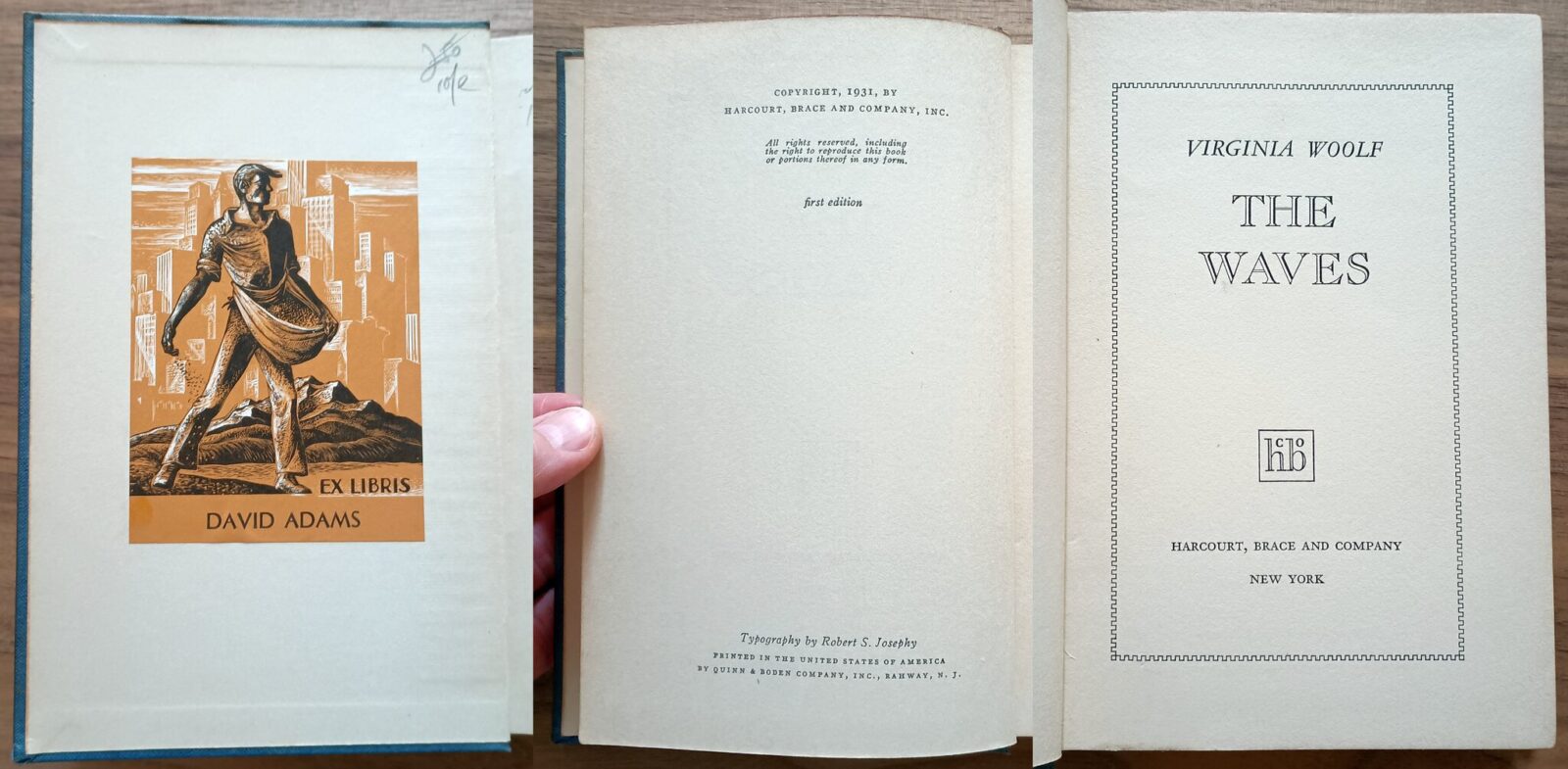
Pasted inside a 1931 First American Edition of The Waves by Virginia Woolf, published by Harcourt, Brace and Company, is a striking Art Deco bookplate entitled ‘Creation’. Designed for a certain David Adams, it is the work of Chicago-born artist Lynd Ward (1905 to 1985), the American illustrator and wood engraver whose wordless novels helped establish the graphic novel in the United States.
Ward is best remembered for Gods’ Man, published in 1929 during the week of the Wall Street crash, a dramatic and Expressionist sequence of wood engravings that influenced generations of artists and writers, including Allen Ginsberg. He went on to publish five further graphic novels, culminating in Vertigo in 1937. At the time of his death, he left another wordless novel incomplete.
The presence of a Ward-designed ex libris inside Woolf’s modernist masterpiece creates an unexpected dialogue between two strands of early twentieth century creativity: British literary modernism and American graphic Expressionism. It transforms the volume from a simple first edition into a layered artefact of private taste and artistic affiliation.
For collectors, such a bookplate can raise interesting questions. Does it detract from the purity of the copy, or does it add character and cultural depth? In the case of an artist of Ward’s stature, the latter argument becomes compelling. What might otherwise be seen as a mark of ownership becomes, instead, a signed or attributable work on paper housed within a landmark literary text.
This is where bookplates and first editions intersect. Both are expressions of authorship. Both carry the imprint of individual identity. And when they align thoughtfully, as in this example, they enrich the story of the book rather than diminish it.
This article draws on material originally published on Ex Libris Art, now revised and expanded.
Related Works on Paper
Collectors interested in Lynd Ward or artist-designed bookplates may wish to explore related works on paper currently available on the market for reference and collecting research.


Signed By Author is an eBay affiliate. We may earn a commission from qualifying purchases.